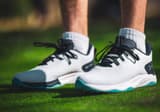
Almost nobody announces a price increase early. Payntr Golf just told the market its shoes go up 10 percent on Jan. 1, 2027, blaming recently implemented U.S. tariffs, which gives buyers roughly fifteen months to act on the information. That is not a defensive disclosure. That is a pull-forward campaign with a compliance memo stapled to the front.
The number that matters is not the 10 percent. It is that the increase pushes certain Payntr models over $250. That figure is a psychological ceiling in golf footwear, the line where a shoe stops being an equipment purchase and starts being a considered one, competing for the same wallet space as a fitted wedge or a shaft upgrade. Payntr built its reputation on a spikeless platform with genuinely different geometry and a lower-profile ride than the mainstream OEM offerings, and it earned a following among players who cared about the ground more than the logo. Crossing $250 means those players now have to justify it against FootJoy, G/FORE and the growing pile of $180 spikeless options that are good enough.
What makes the announcement interesting is the second thing Payntr did with it. Rather than issue a bare price notice, the brand paired it with shoe-care advice: store them cool and dry, untie the laces so the collar stops deforming, brush the outsole with mild soap before the mud sets, pull the insoles after hot rounds, rotate between two pairs. The tips are correct and unglamorous. They are also the opposite of what a footwear brand normally wants you to do. Longevity messaging suppresses replacement cycles, and replacement cycles are how footwear companies make money.
That contradiction is the tell. A brand that tells you to make the shoes last longer is a brand positioning itself as premium durable goods rather than seasonal churn. It is the Barbour argument applied to golf footwear, and it only works if the construction backs it up: a proper removable insole, an upper that does not crease into failure by round thirty, stitching that survives a wet Tuesday. Payntr's outsole engineering has always been the strongest part of the story. The uppers are where a $250 shoe gets judged, and no amount of baking soda fixes a bonded seam that gives out.
The tariff context is the part the whole category should be watching. Payntr is a comparatively small operation without the volume leverage to absorb duty costs quietly, so it went public. The larger footwear players will pass the same costs through, just later and with less explanation, folded into a spring line refresh where nobody can isolate the increase. Payntr's rank on the DORMIED Index sits at 24th with an 18.3 percent month-over-month slide, which suggests attention rather than momentum, and a price-increase headline is not usually the thing that reverses that. But it is honest, and honesty has become a differentiator in a category where every brand is quietly raising numbers and calling it a new colorway.
Watch the fourth quarter of 2026. If Payntr's pre-increase window produces a genuine sales spike, the brand has proved that transparency sells better than silence, and expect three competitors to copy the playbook by the following January. If it does not, the announcement will read as a small brand explaining itself to an audience that was already choosing on price. Either way, Payntr has volunteered to be the test case for how golf footwear talks about tariffs, and the rest of the category gets to watch the results without paying for the experiment.