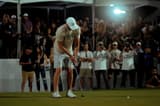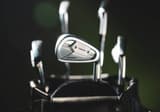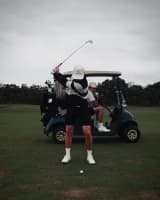
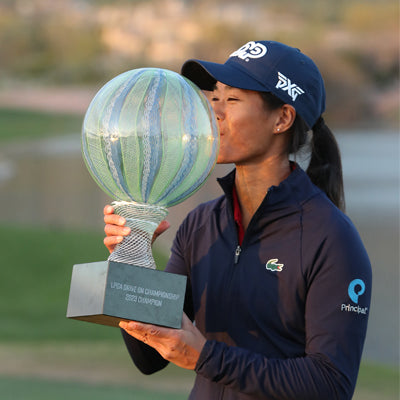
In 2017, PXG paid Lydia Ko to put a full bag of unfamiliar clubs in play while she was ranked No. 1 in the world. She was out of the deal inside two years. That signing, and the half-dozen like it during PXG's launch era, quietly rewrote how the company approaches tour representation. The current roster is the proof.
Who Is on the PXG Tour Staff Today?
PXG published a profile piece this month built around five staffers: Céline Boutier, Eric Cole, Jake Knapp, Megan Khang, and Aldrich Potgieter. On its face it is a fitting funnel wrapped in inspirational copy, with "golf irons" repeated often enough to make the SEO intent obvious. Read the signing dates instead of the prose and something more interesting emerges. Every one of those five joined PXG before the market had priced them. Khang signed as an LPGA rookie in 2016 and then went 191 starts before winning anything. Cole had no equipment deal at all when a PXG rep handed him clubs at a 2022 Korn Ferry event; he earned his card that season and was Rookie of the Year at 35. Knapp was on PGA Tour Canada and the Korn Ferry Tour with PXG already in the bag before he won the 2024 Mexico Open by hitting two fairways in the final round. Boutier joined in 2021 and won Evian in 2023. Potgieter signed in early 2026 and now leads the PGA Tour in driving distance at 329.8 yards.
Compare that to PXG circa 2015 through 2017: Zach Johnson, Ryan Moore, Billy Horschel, Charles Howell III, Chris Kirk, Alison Lee, Ko. Established players, checkbook deals, and a clear purpose. A company nobody had heard of selling $5,000 iron sets needed borrowed credibility, and Bob Parsons had the balance sheet to rent it. The problem with rented credibility is that the lease expires. When PXG cut tour spend and reoriented toward the 0211 price tier and mass retail distribution at the end of the decade, the tour operation had to become something cheaper. It became scouting.
Why Does Signing Unproven Players Work for PXG?
Srixon and Cleveland have run this playbook for a decade, and Ping ran a version of it long before that. It works because iron loyalty is the stickiest relationship in the equipment business. A player who earns a card with your irons in the bag tends to keep them for years, which is why Titleist still shows up in more WITB posts than its marketing budget would predict. The math is also simply better: a Korn Ferry signing costs a rounding error against a top-20 OWGR contract. The risk is that there is no floor. Sign twelve development-tour players in a launch year and you might have zero visible tour presence when the product hits shelves. PXG's five hit, which is a genuinely good conversion rate and not entirely luck.
What the flat data underneath this says is more sobering. PXG sits 13th globally on the DORMIED Index with no month-over-month movement, which means a roster with a major championship, a 59, a Rookie of the Year, and the Tour's distance leader is not by itself moving brand consideration. That tracks. Tour wins have never sold PXG. Fitting sells PXG. The company built its identity on a bay, a launch monitor, and 90 minutes of attention, and the CTA at the bottom of this piece is a fitting appointment, not a product page. Every player story in it is scaffolding for that ask.
What Is the Untested Risk in PXG's Tour Strategy?
The untested half of the strategy is retention. Discovery is cheap; keeping Potgieter when Callaway and TaylorMade come with an eight-figure number at 24 is the expensive part, and PXG has never successfully defended a star it did not develop. Ko's exit was the early warning. Watch what happens the first time a homegrown PXG player reaches free agency with real leverage. That negotiation, not the next iron launch, is where this approach either compounds or reveals itself as a farm system feeding somebody else's roster.