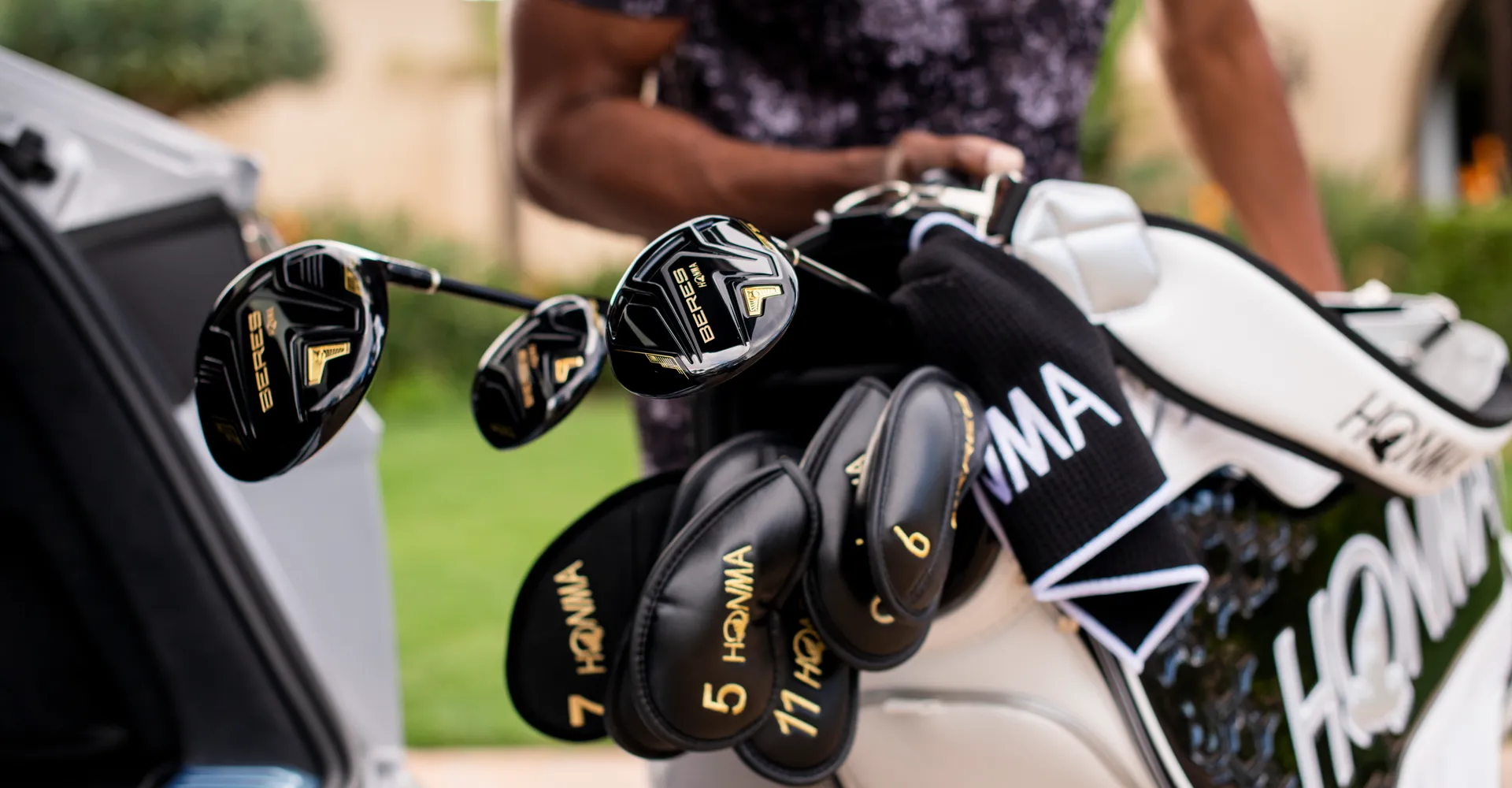

Yuna Nishimura won the Walmart NW Arkansas Championship wire-to-wire at 21-under, and the most interesting thing in her bag was a club she asked Callaway to build. The Quantum Mini Spinner 7-wood, launched in July, exists because Nishimura told Callaway her fairway woods flew high enough but would not stop on the green. Callaway's answer was a 21-degree head that gains her roughly 600 to 700 rpm of spin over what she was playing, with a higher peak height on top of it.
Tour feedback loops are not new. What is unusual here is that the request was for less distance. Equipment R&D has spent three decades optimizing in one direction: lower spin, faster faces, more ball speed. The Mini Spinner is engineered against all of that. Carbon sole, weight positioned high in the head to raise spin rather than suppress it, a deeper face, Callaway's Step Sole, and a shaft playing three-quarters of an inch shorter than a comparable 7-wood. That is a club designed to trade total yardage for a steeper landing angle, and Callaway put it into retail rather than leaving it as a one-off tour build.
Why Did Callaway Build a Fairway Wood That Spins More?
The commercial logic is better than it first appears. The 7-wood has quietly become the most important club in professional golf's long-game reshuffle, and it is one of the few categories where tour adoption and recreational need point the same direction. Nishimura's winning setup ran driver, 3-wood, 5-wood, 7-wood, hybrid, and then a 6-iron as her longest iron. No 4-iron, no 5-iron, nothing above the 6 asking to be struck perfectly to work.
That is the configuration most amateurs should already be playing and mostly are not. The hybrid replacement wave of the mid-2000s, when TaylorMade's Rescue and Adams' Idea lines pushed long irons out of thousands of bags, solved half the problem. It got the ball airborne. It did not solve descent angle. A player who can carry a 5-iron 175 yards and lands it at 38 degrees still cannot hold a firm green. The Mini Spinner is aimed precisely at that gap, and it is the rare tour-driven product where the professional's problem and the 14-handicap's problem are the same problem.
How Does the Mini Spinner Differ From a Standard Fairway Wood?
The shorter length is the detail worth noting. Three-quarters of an inch is a meaningful change in a category where OEMs have fought for years to keep fairway woods long enough to protect ball speed numbers on the launch monitor in the fitting bay. Callaway is conceding yardage in the one environment where yardage sells clubs. That takes some institutional nerve from a company that built its reputation on Big Bertha distance claims going back to 1991.
It also fits a pattern Callaway has been running since the Elyte and Quantum lines arrived: segmenting fairway woods by shot shape and function rather than by player handicap. The Max, Max D, and now Mini Spinner naming convention asks the buyer a different question at the rack. Not how good are you, but what shot do you need. Fitters have wanted that framing for a decade. The brand's visibility jumped sharply this month, and a tour win built on a club with a weird, specific purpose is exactly the kind of story that travels further than a standard driver launch.
What Does Nishimura's Win Signal for the 7-Wood Category?
The risk is that Mini Spinner stays a specialty SKU. Clubs that promise less of something historically struggle at retail no matter how right they are, and the golfer who needs more spin is rarely the golfer who thinks he needs more spin. Callaway has not solved that. It has solved the engineering half and handed the rest to fitters and to tour validation, which is what Sunday provided.
Watch whether the rest of the lineup follows. If Callaway extends the high-spin, short-length construction into a 9-wood or a matched set of utility woods, it is building a real category rather than a niche product. If Mini Spinner remains a single loft sitting beside a conventional Quantum Max, it was a favor to a tour player that happened to win a tournament. The first one is a more interesting company.