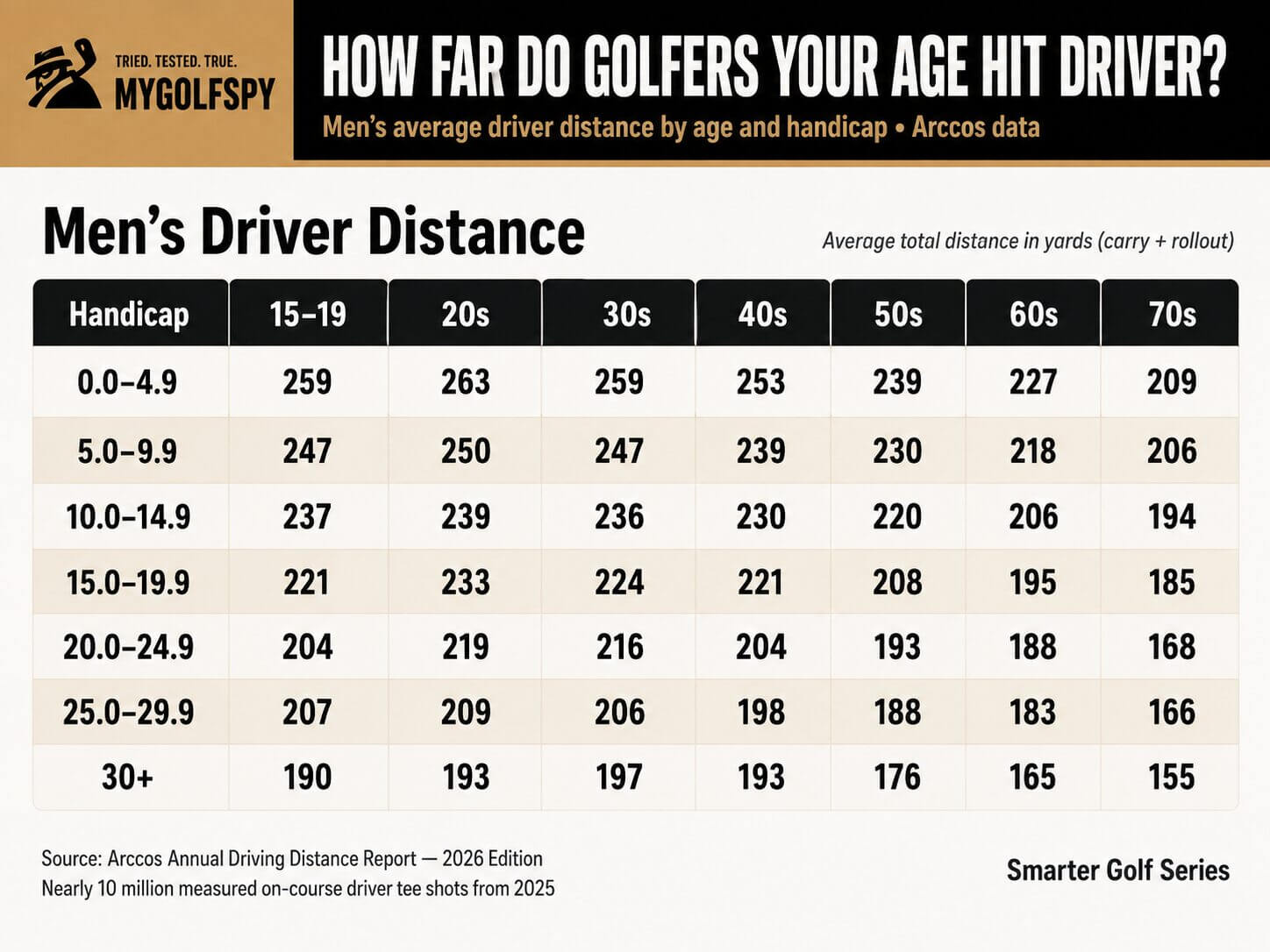
Across the entire men's age-and-handicap matrix, one cell breaks 260 yards: 0.0 to 4.9 handicaps in their 20s, at 263. Every other combination of age and skill in the dataset, including scratch players in their 30s and 40s, comes in under it.
What Does the Arccos Driving Distance Report Show?
That number sits inside the 2026 edition of the Arccos Annual Driving Distance Report, published this month through MyGolfSpy and segmented by age for the first time in a way that treats handicap and age as separate variables. The sample is a random draw of more than 37,000 golfers, each with at least 100 driver tee shots from verified rounds, totaling close to 10 million on-course drives on par 4s and par 5s during the 2025 calendar year. Total distance, carry plus rollout, unadjusted for weather, turf or elevation.
The segmentation is what makes it useful. A male 0.0 to 4.9 averages 263 in his 20s, 253 in his 40s, 227 in his 60s and 209 in his 70s. Over the same span, fairways hit climb from 42 percent to 60 percent. That is a 54-yard loss paired with an 18-point accuracy gain, and it is the single most valuable line in the report, because it separates aging from decline. The 65-year-old three-handicap benchmarking himself against a 25-year-old three-handicap is using the wrong comparison set. The women's data makes the same point harder: a 0.0 to 4.9 averages 244 in her 20s and 184 in her 60s, which is why any single "average female driving distance" figure is close to useless.
Why Do Driver Claims Ignore Amateur Golf Distance Data?
There is a category problem buried in this. Driver marketing has been built on incremental yardage claims for three decades, and the population being sold to averages, in nearly every age and handicap bracket, somewhere between 190 and 250 yards of total distance. When the USGA and R&A published the Distance Insights Report in 2020, the case for a rollback rested largely on elite play. Arccos data has been the quiet counterweight ever since: recreational distance has moved barely at all across the years the company has been publishing it. Two different sports, one set of rules, and one set of marketing claims aimed at the group that has gained nothing.
The elevation figure is the tell about what this dataset actually is. A representative 10-handicap averages 220.5 yards at sea level and 239.7 above 5,000 feet, a 19-yard spread that Arccos leaves in rather than scrubbing out. That makes it worse science and better product. Nobody plays golf under normalized conditions, and a launch monitor carry number compared against this chart is a category error. It also explains the pitch attached to the report: Arccos Air, the sensor-free version that captures shots without screwing a tag into every grip. The company's moat was never the hardware. Game Golf proved hardware alone does not survive. The moat is that no OEM, no governing body and no publisher owns 10 million verified amateur drives from a single season, and the install base that produces it is the asset. Cobra Connect, which embedded Arccos sensors in King F7 grips back in 2017, was the first sign that OEMs understood whose data it was.
Why Does Arccos Golf Publish the Report Through MyGolfSpy?
Which makes the flat month curious. Arccos sits 27th globally in the DORMIED Index with no movement at all, while producing the single most-cited equipment-adjacent dataset in golf and handing its distribution to MyGolfSpy rather than building the audience on owned channels. That is a reasonable trade for reach and a bad one for brand equity, and it is the same trade Arccos has made with this report for several years running. The next move worth watching is whether the company starts licensing this data to OEMs and fitters as a product line rather than releasing it as content. The dataset is worth more than the subscription attached to it. At some point somebody at Arccos is going to price it that way.