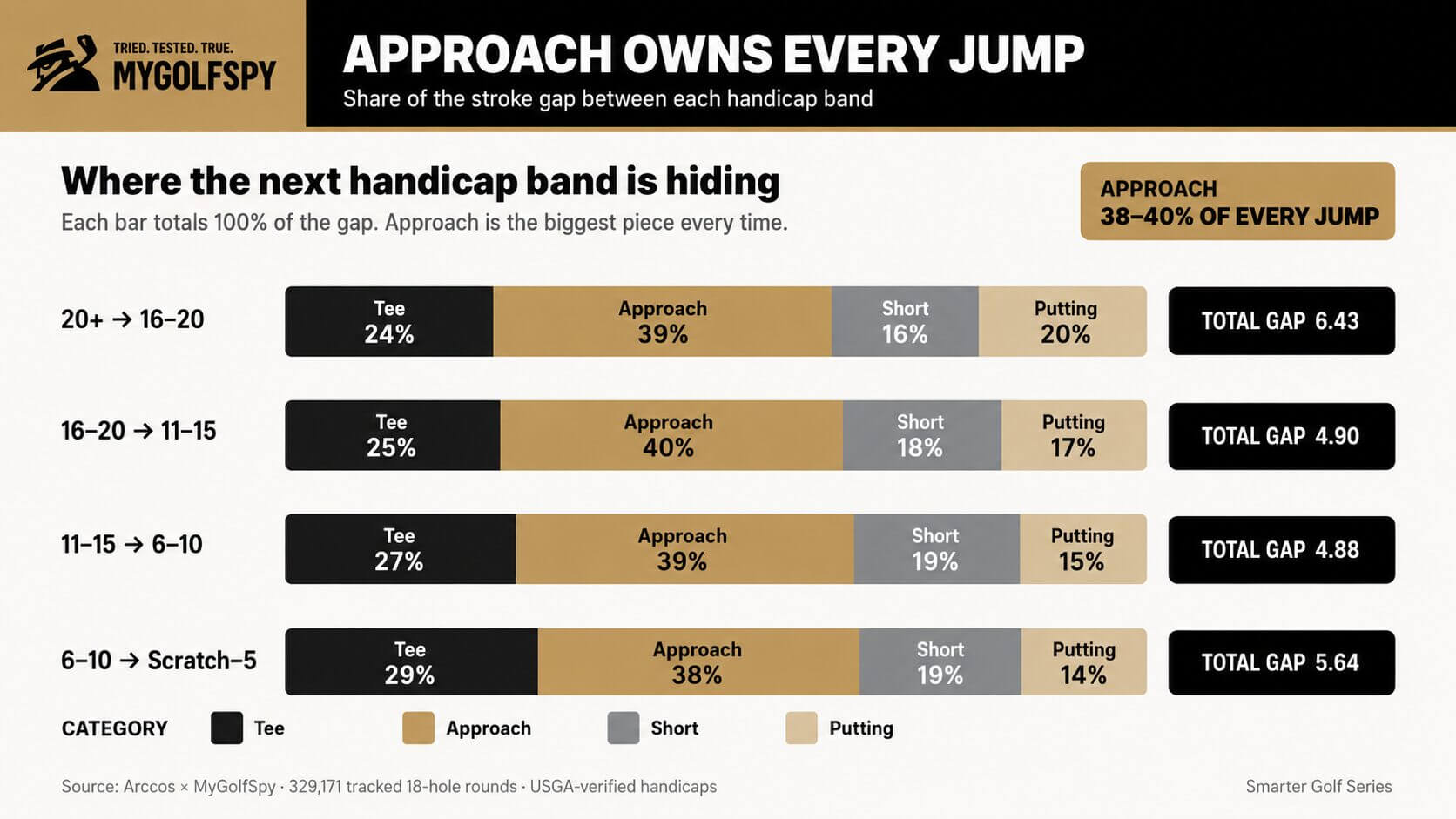
Approach play accounts for roughly 40 percent of the stroke gap between handicap bands, regardless of where a golfer sits on the ladder. Putting, the category most amateurs blame first and practice last, never rises above a fifth of the gap and drops to 14 percent for single digits. That is the headline finding from Arccos Golf's latest data release, drawn from 329,000 rounds logged by 21,000 USGA-verified handicaps over the past year.
The study, published in partnership with MyGolfSpy under a new Smarter Golf series, breaks down the median stroke difference between adjacent handicap bands and assigns it to four categories: driving, approach, short game, putting. The methodology, medians instead of averages, filters out the blow-up round that skews most amateur self-assessment. What is left is a cleaner read on where strokes actually hide.
The more interesting finding sits underneath the approach-play headline. Tee shots grow in importance as handicap drops. A 20 trying to break into the teens gives up 24 percent of the gap off the tee. A six trying to reach scratch gives up 29 percent. The old range-lesson wisdom, that beginners should focus on driving and better players should focus on wedges and putting, gets inverted by the data. Approach and driving together account for two-thirds of every band jump, at every level.
The strategic read for Arccos matters more than the individual stat. The company has been sitting on the largest ShotLink-adjacent dataset in amateur golf for a decade, and until recently that data mostly powered the app's own recommendations. Publishing it through MyGolfSpy, which has spent years building the largest data-literate audience in golf media, is a distribution play. Arccos is trading proprietary insight for reach, betting that a chart every 15-handicap will screenshot is worth more than a whitepaper only current subscribers see. Shot Scope tried a similar content strategy in 2022 with less structured data and less editorial muscle. The MyGolfSpy partnership solves both problems.
There is also a product tell buried in the closing lines. The article ends with a pitch for Arccos Air, the sensor-free tracking system launched to compete with Shot Scope's V3 and Garmin's Approach line. Arccos spent a decade selling grip sensors as the moat. Air abandons that moat in favor of passive tracking, and this content series is the softest possible way to introduce the product to golfers who bounced off the sensor requirement. The chart is real. The chart is also a funnel.
The broader industry implication: amateur golf's practice economy still runs on putting greens and short-game areas, but the data increasingly says the range is where handicaps actually move. Trackman bays, GCQuad fittings, and approach-focused instruction platforms like Skillest are aligned with what Arccos is publishing. Traditional teaching, which still weights short game heavily in the beginner-to-intermediate curriculum, is not. Whichever side adjusts first captures the next wave of improvement-minded amateurs.
Arccos has spent most of 2026 quiet on the product side and loud on the data side. The DORMIED Index has them at 28 with flat month-over-month movement, which tracks with a brand executing on distribution rather than launches. The next test is whether the MyGolfSpy series drives measurable Air conversions by the end of the summer season, or whether the chart lives on Reddit forever as a screenshot with no attribution. One outcome funds the next study. The other explains why brands stop publishing them.