
The foundries in Taiwan that press driver heads for the largest OEMs in golf will also press one for a company whose entire engineering history is graphite tubes. That arrangement, not marketing spend or patent portfolios, explains most of what happened in MyGolfSpy's 2026 driver test.
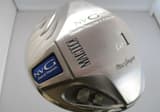
LA Golf's first driver finished first for accuracy in that test. Vice's VGD01+ recorded the highest average ball speed in the field. Takomo's $319 Ignis D1 posted an 8.5 overall score, placing it in the same conversation as heads selling for nearly twice that. Three brands with no meaningful internal R&D operation landed on categories the major OEMs treat as home ground, and they did it in a year when the price spread between the cheapest and most expensive driver in a serious test has never been wider.
The clone era of the 1990s proved that a contract factory could copy a shape. What is different now is that the factory holds the engineering knowledge, not just the tooling. Titanium body construction, carbon crown lamination, variable face thickness and internal weight tracks are all processes a supplier has run thousands of times for somebody else. A brand arriving with a design brief and a purchase order is buying access to a decade of accumulated manufacturing competence it never had to fund. Yesterday's driver technology, executed cleanly, is very good, and the ceiling on center-face performance has barely moved since the CT limit locked everyone into the same face.
Which makes it worth asking what LA Golf actually won. Accuracy is the most flattering possible result for a first-generation head and also the most revealing. A high-MOI, low-and-back CG, conservatively shaped driver is the safest thing a foundry can build for a first-time client, and it tends to produce tight dispersion rather than headline ball speed. What that process does not buy is a face optimized for the four or five impact locations where most golfers actually live. The remaining R&D money at Titleist, Ping and TaylorMade is going toward keeping speed and spin predictable off the toe and low on the heel, and toward building three or four head variants with real fitting differences between them. Those advantages do not present themselves in ten swings on a launch monitor. They show up on the eighteenth tee when the swing is tired, which is precisely why they are so hard to sell against a number.
The business logic for a shaft company is more interesting than the test result. LA Golf built its name selling $400 to $600 aftermarket shafts to golfers who already owned drivers, a market with high margin and a hard ceiling on volume. A head lets it sell the shaft again inside a complete club, capture the assembly margin, and reach the buyer at the moment of purchase rather than a year later when the club disappoints. Bryson DeChambeau's association gave the brand shaft credibility that transfers imperfectly to heads, but it transfers. The brand sits tenth of 215 on the DORMIED Index at a 30.08 score, flat month over month, which is roughly what a strong niche identity looks like before a product broadens it.
The risk is the same one that has caught every foundry-sourced brand that got a good first review. A single accurate head is not a lineup. Winning a category in year one creates the expectation of a year two, and year two is where the fitting matrix, the loft options, the low-spin variant and the tour van support start to matter. Those are cost centers, not design problems, and they are what the big R&D budgets are really funding.
Watch what LA Golf launches next and how many SKUs come with it. A second driver that is one head in three lofts is a shaft company selling a club. A second driver that arrives with a genuine fitting architecture is a shaft company becoming an equipment company, and that is a considerably more expensive thing to be.