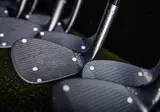

Making a wedge head that spins is no longer difficult. That is the uncomfortable subtext of MyGolfSpy's 2026 Most Wanted Wedge test, and it should worry the people who price wedges for a living more than the result itself does.
How Did Kirkland GEN 3 Win Most Wanted Wedge 2026?
The Kirkland Signature GEN 3 Forged won the thing. Fifteen models, 240 hours, 11,400 shots, every wedge at 56 degrees, full swings plus 50-yard shots in dry and artificially wet conditions. Kirkland scored 9.1 overall. The Titleist Vokey SM11, which has been the reference point in this category for the better part of two decades, finished third at 8.9. Kirkland sells three wedges for $199.99. Vokey sells one for about the same.
The spin numbers are the part worth sitting with. On full swings Kirkland produced 9,429 rpm against Vokey's 9,062. On a dry 50-yard shot it was 6,891 to 6,857, which is a rounding error. Vokey won the spin category on the wet test, holding 6,860 rpm while Kirkland dropped to 6,668, and that is a real and defensible advantage in soft conditions. But accuracy carries 50 percent of the score, spin 30 and consistency 20, and Kirkland took accuracy 9.1 to 8.9 and consistency 9.0 to 8.4, mostly through tighter dispersion rather than better distance control. A $67 wedge matched a $200 wedge on the physics.
What Do the 27 Titleist Vokey Grinds Actually Buy?
Which means the money in a Vokey was never really in the head. It is in the 27 loft, bounce and grind configurations across six standard grinds, the 44-through-60 loft ladder that lets a fitter build around whatever your iron set ends at, the four separate 56-degree options ranging from an eight-degree M Grind to a 14-degree F Grind. Kirkland gives you 52, 56 and 60. One sole, one bounce, take it or leave it. That is not a shortcoming of the product, it is the entire reason the product costs what it costs. Carrying 27 SKUs per loft is an inventory and distribution problem, and solving inventory problems is expensive in a way that forging steel is not. Titleist's moat is a warehouse and a fitting network, not a groove.
The strategic read is sharper than a price-war story. Wedges are the only consumable club in the bag. Grooves wear, and a golfer who practices seriously is replacing them on a two-year cycle while the driver sits there for five. Kirkland is not competing for the fitted player who knows he needs 12 degrees of bounce on firm turf. It is competing for the much larger group who have been playing rounded-off grooves for three seasons because replacing three wedges costs $600. Costco just made that number $199.99, and it did it in the one category where the replacement purchase, not the first purchase, is the volume.
Why Doesn't Kirkland Golf's Win Show Up in Brand Terms?
None of this shows up in brand terms, which is its own lesson. Kirkland Golf sits at 143rd of 215 globally, down nearly 21 percent month over month, with a DORMIED Index score under one. It has no tour staff, no fitting van, no marketing department in any conventional sense, and it just won an independent test against the category benchmark. Product performance and brand equity are separate currencies, and Kirkland is only earning one of them.
What to watch is whether Costco ever adds a second bounce option. Right now Kirkland is a fixed-spec product priced like a fixed-spec product, and Vokey's fitting matrix is a genuine reason to spend three times more. The day Kirkland offers a low-bounce 60 alongside the standard one, that argument gets a lot thinner, and Titleist's wedge margin gets a lot more interesting to talk about.