Equipment brands do not build calculators to educate golfers. They build them because a form with four input fields converts better than a product page, and because the output can be engineered to end in an appointment. PXG has now built one for wedges.
How Does the PXG Wedge Gapping Calculator Work?
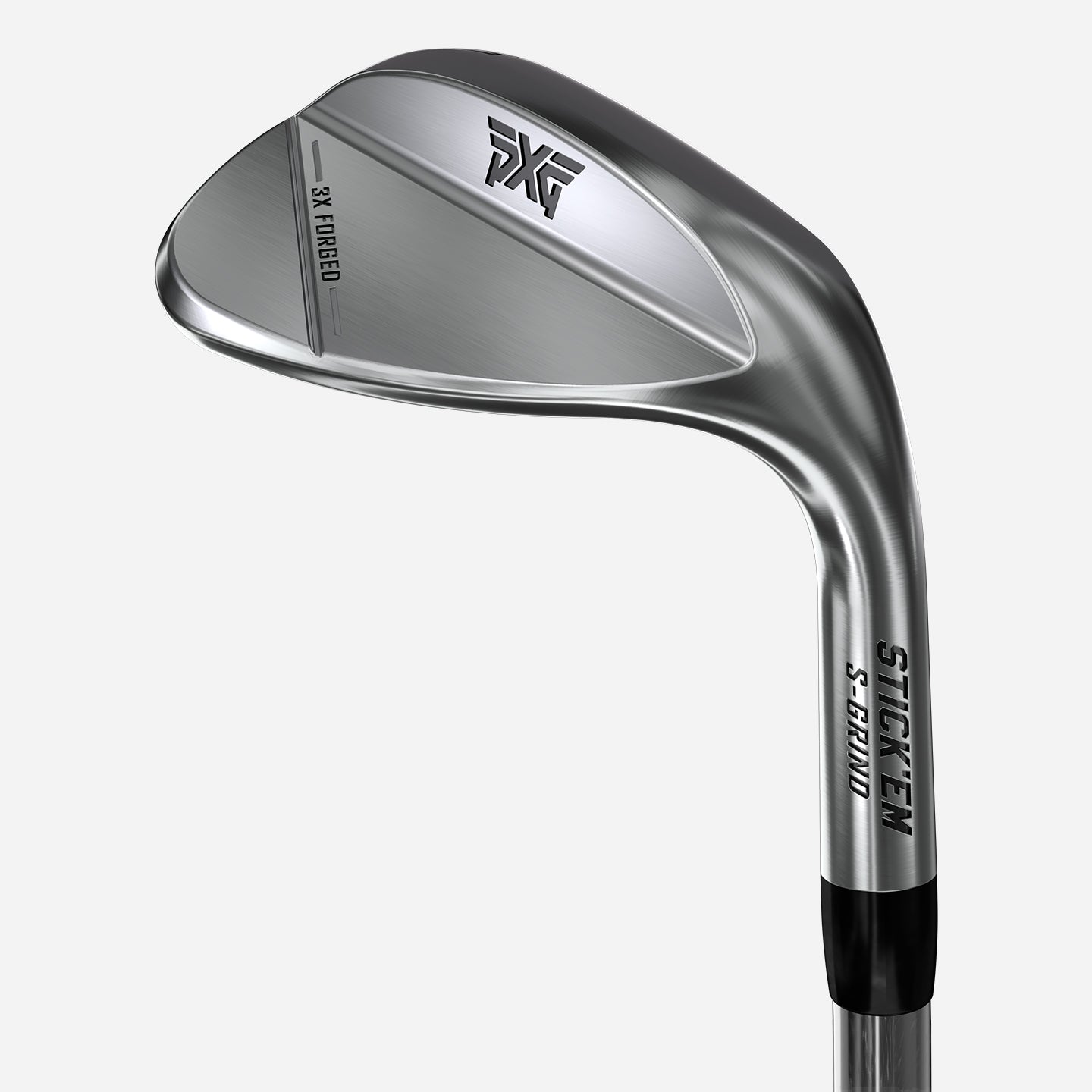
The tool asks for the highest-lofted club in your iron set and its carry distance, optionally your 8-iron and 7-iron numbers, and the loft and carry of your highest wedge if you have one. It returns up to three recommended PXG wedge lofts, framed explicitly as a starting point, and routes you to a PXG Fitting Specialist to validate the numbers. The lofts on offer run 50 through 60 degrees in two-degree increments across two families: Stick'em Forged at $199 and Sugar Daddy III 100% Milled at $299.99.
This is not new ground. Titleist has run a Vokey wedge selector for years, and it remains one of the most efficient email-capture assets in the category. Cleveland has done versions of the same. Ping built nFlight to solve the fitting-at-a-distance problem more than a decade ago. What separates PXG's version is where the funnel terminates. Titleist's selector ends at a retail SKU and a fitting cart. PXG's ends at a PXG Master Fitter in a PXG studio, because PXG owns the fitting layer of its own distribution in a way almost no other OEM does. The calculator is not a content play. It is appointment-booking infrastructure with a loft chart on the front end.
Why Do PXG Sugar Daddy III Wedges Cost More?
The product ladder underneath it explains the design. Both wedges are three-times forged from 8620 soft carbon steel, which is the same starting material and the same grain-refinement argument. The $100 difference buys 100% CNC milling, a third sole grind in the C-Grind, and Precision Weighting Technology, an adjustable weight near the CG that moves in two-gram increments. Here is the tell: that weight is adjusted during a fitting. The premium wedge is functionally incomplete without the appointment. A calculator that pushes golfers toward a fitter is a calculator that pushes golfers toward the $299.99 SKU. That is coherent strategy, not an accident of layout.
The weak point is the input. The tool runs on carry distances, and most amateurs do not know theirs. They know their best 9-iron, which is a different number from their average 9-iron, usually by eight to twelve yards. Feed a flattering 9-iron into any gapping model and the recommended wedge lofts drift strong, which is how golfers end up with a 52 and a 56 covering a range they actually hit with a 50 and a 54. PXG hedges this correctly by labeling the output provisional and pointing users at a launch monitor, but the hedge is also the point. The calculator is not designed to be right. It is designed to make you uncertain enough to book.
Why Does Wedge Gapping Land on Three Wedges?
The loft-to-distance rule the brand cites, roughly two to three yards per degree, is real and worth internalizing regardless of who sells you the wedge. It also quietly constrains the answer. With two-degree increments and a fourteen-club limit, almost every honest gapping exercise lands on three wedges. PXG sells three wedges. The math and the catalog agree, which is convenient but not dishonest.
PXG sits 13th in the DORMIED global rankings and moved zero percent month over month, which is the profile of a brand building infrastructure rather than launching product. Wedges are the most fitting-resistant category in the bag, the one where golfers buy on feel, tour count and habit rather than measurement. A company built on fitting attacking that category with a measurement tool is the logical move. Whether it works depends on something PXG cannot control: how many golfers are willing to admit they do not know how far they hit a 9-iron.