
Skipping the halo product to ship the forgiving one first is not how badge-rental golf brands behave. McLaren Golf launched in April with two irons, prioritized the more forgiving Series 3 after fitter feedback and inventory reality, and left its muscleback idling for five months. The Series 1 now has a date: inventory arrives at the end of September, at $375 per club.
That sequencing is the most informative thing about the brand so far. A licensing play leads with the blade, because the blade is the image product and nobody expects to sell many. Blades are a rounding error in iron unit volume. McLaren instead put its limited first-year manufacturing capacity behind the club that actually moves through Club Champion and True Spec fitting bays, then came back for the trophy piece. That is a decision made by people who have shipped golf clubs before, which tracks: Ryan Badgero ran product development at COBRA, JP Harrington came out of Titleist and JP Wedges, and Jacob Sanborn has Wilson and Callaway on his resume. Justin Rose, Michelle Wie West and Ian Poulter are ambassadors and investors, a structure PXG's tour relationships and half a dozen upstarts since have normalized.
Why Are McLaren's Series 1 Irons Metal Injection Molded?
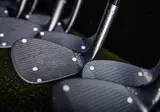
The manufacturing choice is the part worth understanding. Series 1 is neither forged nor cast. It is metal injection molded from a steel blend McLaren will not disclose, meaning fine metal powder mixed with a polymer binder, injected into a mold, debound, then sintered. What emerges is a near-net shape with tighter tolerances and fewer grinding and polishing steps, and every grinding step removed is one fewer chance to introduce head-to-head variance inside a set. MIM is not new to golf. Ping used it for the Glide Forged Pro wedges precisely because it holds detail a forging cannot. What is new is a first-year brand building its entire iron catalog around it, and the reason is structural: MIM lets you hollow out a traditional muscleback and load it with internal tungsten bars ranging from 16 to 24 grams, tuned per loft, without owning a forging supply chain or paying for the labor that follows one.
The rest of the spec sheet is coherent rather than radical. Progressive CG, low in the long irons and rising into the scoring clubs. A honeycomb structural mesh in the cavity that saves mass and gives the brand the closest thing it has to a visual signature. Injection-molded silicone for vibration damping. Progressive offset that is genuinely aggressive by blade standards, four millimeters in the 3-iron down to 1.2 mm at the pitching wedge. Lofts at 20, 34 and 46 degrees for the 3, 7 and pitching wedge. Left-handed availability in year one on a muscleback is the quietly expensive commitment on that list, and most established OEMs do not make it.
What Is the McLaren Series 1 Price and Where to Buy?
Then there is the price. Seven clubs, 4-PW, is $2,625. Add the 3-iron and it is exactly $3,000 before a shaft or grip upgrade, with £360 and €420 per club abroad. McLaren is not hedging on that number, and the distribution matches it: direct at mclarengolf.com with a five- to six-week lead time, plus Fairway Jockey at roughly two weeks, Club Champion and True Spec across North America, Europe and South Korea. No green grass, no big box, no discount channel to leak into. PXG proved in 2015 that a premium direct iron business can exist at that price. It also spent the following decade learning what happens when the launch buzz decays and there is no shelf presence to fall back on.
McLaren has already felt some of that decay, sitting at 72nd globally with a 33 percent month-over-month drop heading into the September arrival. April's coverage, including the Rose start at Doral that went badly and got loud, has burned off. The Series 2 is penciled in for early 2027 and the other eleven clubs are still described as in development. What happens between now and then is the real read: whether a car company with a legitimate golf engineering staff can convert fitting-bay availability into repeat orders, or whether Series 1 becomes the most technically interesting blade almost nobody bought.