Count the mentions. In the announcement out of Power Tee this month, Trackman appears exactly once, wedged into a list between "state-of-the-art driving range" and "miniature golf." The 25 percent revenue growth quote from the operator goes entirely to the machine that tees the ball up, not the machine that measures where it goes. For a company that spent a decade making its name the generic term for ball flight measurement, that is a demotion worth paying attention to.
What Did the Power Tee Automated Teeing System Change?
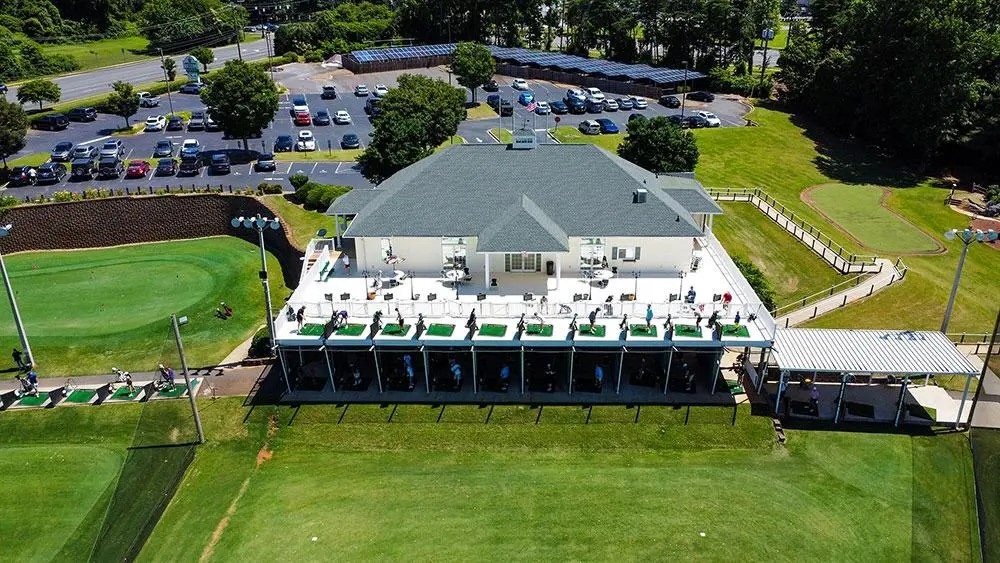
The news itself is small: Leatherman Golf Learning Center, a practice and entertainment facility in Charlotte, North Carolina, has installed 34 Power Tee automatic teeing systems across its range and reports revenue up more than 25 percent since. Owner Chris Leatherman was explicit about why the deal cleared his desk: he leased the hardware rather than buying it. "That flexibility made the decision much easier for us," he said, "and allowed us to modernize the range without a significant initial expense." Power Tee, founded in 1996 and now headquartered in Jacksonville with a European base in Swindon, has installations at St Andrews, The Belfry, Celtic Manor and Dromoland Castle. The release carries a Jacksonville dateline for a Charlotte facility, which tells you whose press office wrote it.
The useful insight here is about revenue mechanics, and it is not flattering to launch monitor companies. An automated teeing system does one thing to a range P&L: it removes the seconds between shots. Fewer seconds between shots means more balls hit per hour, which means more buckets sold per bay per hour. That is a throughput product, and throughput products have a revenue math an operator can model on a napkin. A ball-tracking layer does something different. It extends dwell time, raises the price you can charge for a bay, and gives the teaching operation something to sell. Both are real. Only one of them shows up as a clean percentage in a quote from the owner.
Why Did Toptracer Build Range Coverage Faster Than Trackman?
The financing structure matters more than the hardware. Range operators are small-margin, weather-exposed businesses that got burned in 2020 and then whipsawed by the participation boom that followed. They now buy technology the way restaurants buy point-of-sale systems: monthly, cancellable, off the balance sheet. Toptracer understood this early. After Topgolf acquired the underlying technology in 2016, it went to market on a recurring per-bay basis rather than a capital hardware sale, and it built range coverage faster than anyone expected. Trackman came at the same category from the opposite end, with tour-grade radar accuracy, a fitting and teaching credential no competitor could match, and a price that reflected it. That worked when Trackman was selling to coaches and fitters. It works less well when the buyer is an owner deciding between a lease on 34 teeing units and a capital commitment to a tracking layer.
None of this makes Trackman's technology worse. It makes Trackman's position in the stack less visible, and visibility is the thing that decays quietly. The brand slid more than 18 percent month over month in DORMIED's global brand ranking, sitting 27th of 215, which is roughly where you would expect a company to land when it becomes infrastructure: present in every facility description, credited in none of them. Intel spent fifteen years solving that problem with a sticker and a five-note jingle. Golf technology has no equivalent, and the OEM installed at the back of the bay does not control the press release.
What Should Trackman Change in Its Range Technology Pricing?
The question for Trackman over the next 18 months is whether it wants to be the reference instrument or the range platform, because the two require different pricing, different sales motions and different marketing. It has the better radar and it has the tour credibility, and neither of those is what a Charlotte range owner is optimizing for. Watch for a leasing or per-bay structure on the range side. If it does not come, expect more announcements like this one, where Trackman is a feature in somebody else's story.