303 stainless exists because someone added sulfur to 304 to make it easier to cut. It machines fast, chips clean, and burns through fewer tools, which is why most milled stainless putters are made from it. 316L is the opposite proposition: gummy under a cutting tool, harder on tooling, slower through the machine, and specified almost exclusively when something is going to live near salt water. Toulon Golf built its entire Coastal California Series out of it.
What Is in the Toulon Golf Coastal California Series?
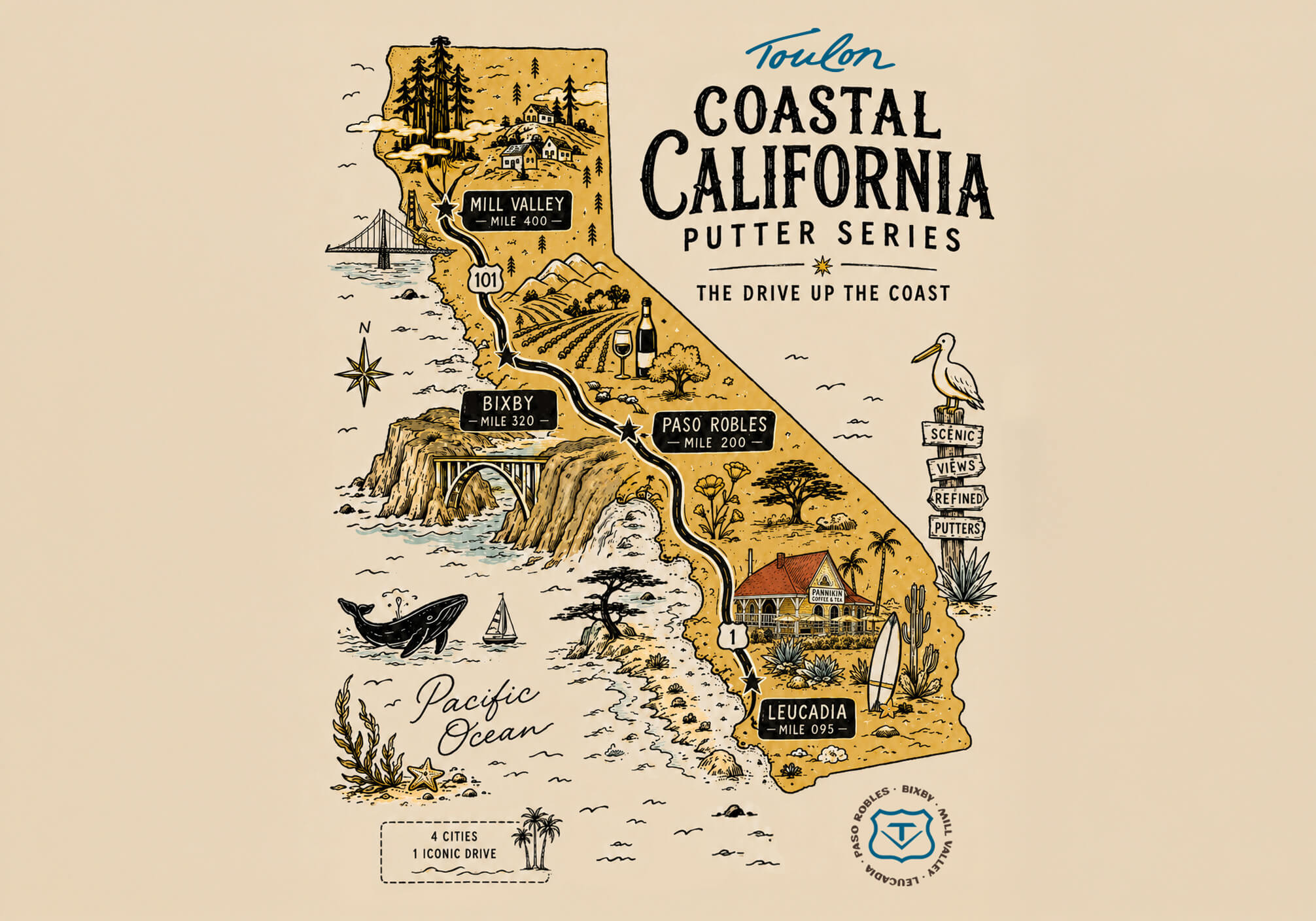
The series is four limited-edition putters, released one per day across four days, each named after a stop on the drive north from San Diego to the Bay Area: Leucadia, Paso Robles, Bixby, Mill Valley. All four carry a Golden Sand PVD finish paired with Ocean Blue paintfill, and all four use a new face milling pattern whose shield-shaped cutouts are lifted from California highway signage. The Leucadia, revealed first, is the only blade in the group: a tri-soled Anser profile with a smooth-edged plumber's neck producing 45 degrees of toe hang, borrowing geometry from Toulon's existing San Diego and Santa Monica heads.
City names are not new here. Sean Toulon built the brand on them before Callaway acquired it in 2016, and the catalog has run through San Diego, Chicago, Memphis, Atlanta, Las Vegas and Latrobe. What changed is the resolution. The naming convention used to span the country. This one spans about 500 miles of coastline, and it opens in a beach town that sits a short drive up Highway 101 from Callaway's Carlsbad campus. A putter line named after the neighborhoods its engineers commute through is either charming or insular, and which one it reads as depends entirely on whether the golfer buying it has ever been there.
Why Release Limited Edition Milled Putters Over Four Days?
The daily-reveal cadence is the more interesting decision. Releasing four SKUs across four days is a sneaker mechanic, and in golf it has one dominant precedent: Scotty Cameron's Gallery and Circle T releases, which established that a milled putter's resale market is a marketing channel. Bettinardi runs the same logic through the Hive. Scarcity is close to the only defensible position left at the top of the putter category, because the two flanks are gone. Odyssey owns volume, including Toulon's own corporate shelf space, and L.A.B. spent five years taking the technical argument off the table by selling lie-angle balance as physics rather than romance. A brand that cannot out-engineer L.A.B. or out-distribute Odyssey is left selling story, finish and limited run counts. That is not a criticism. It is the job description.
The blade-to-mallet ratio is the tell about who Toulon thinks is buying. One blade in four, in a market where mallets have carried the majority of putter sales for most of the last decade, is a ratio aimed at players rather than shelf collectors. Pure collector drops skew blade, because blades photograph better and hold value more predictably. Three mallets in a four-putter limited series suggests Toulon wants these in bags, not in cases, which is a healthier long-term position than the alternative even if it moves fewer units on day one.
Does the Series Fix Toulon Golf's Visibility Problem?
What the release does not do is move the brand's visibility problem. Toulon sits 93rd of 215 in the DORMIED Index this month, flat month over month, which is roughly where a premium sub-brand lands when its parent company handles the mainstream conversation. Limited runs unveiled over four consecutive days generate a spike in a specific corner of the enthusiast internet and very little beyond it.
The question worth tracking is whether this becomes a franchise. A geography-based naming system is a renewable asset if the brand treats it like a calendar: Coastal California this summer, a different corridor next year, the same finish language and the same drip cadence, until the series itself is the thing people wait for. Toulon has the naming convention and now has the release mechanic. What it has not yet demonstrated is the discipline to run the same play twice.