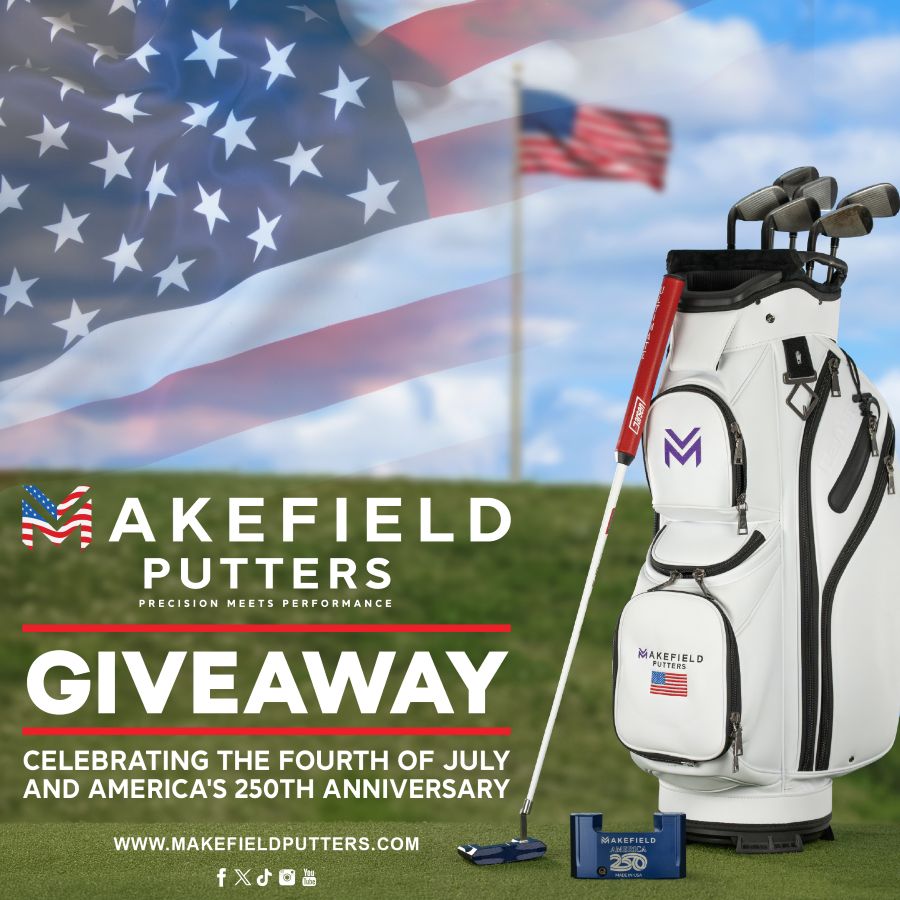
American manufacturing as a putter marketing pillar has a mixed track record. Bettinardi built a brand on it. SeeMore leaned on it. PXG waved the flag briefly and then quietly moved most of its production offshore. Makefield Putters is choosing this moment, America's semiquincentennial, to plant a flag on the one claim that most of the golf equipment industry can no longer make.
What Is Makefield Putters Giving Away This July?
The Bensalem, PA-based putter maker is running a giveaway around a one-off custom Defiant in royal blue, built with the limited-edition KBS Tour GPS USA white shaft (#51 of 100 produced) and a Garsen Ultimate Red grip. The engraving marks America's 250th anniversary. The entry mechanic is standard social-tag stuff, running through July 14. The interesting part is not the giveaway. It's the positioning.
Makefield designs, machines, assembles, and finishes in the United States. That sentence used to be table stakes for a premium putter brand. It isn't anymore. Scotty Cameron still mills in Carlsbad, Bettinardi in Chicago, Byron Morgan and a handful of boutique builders keep production stateside. Beyond that short list, the supply chain for what golfers casually call "American-made" has been quietly relocating for two decades. Head machining in Taiwan, shaft production split between Japan and Vietnam, assembly consolidated wherever margin dictates. The KBS Tour GPS USA shaft featured in this build is itself the exception that proves the rule: KBS's premium production runs are among the few remaining domestic shaft operations at scale.
What Makes Makefield Different From Premium Putter Brands?
The X3 Weighting System is Makefield's actual engineering argument, offering one of the wider customizable head-weight ranges on the market and pitched around stroke torque-to-path fitting. That's a legitimate technical claim, and one that should get more airtime than it does. The Hal Sutton and John Maginnes endorsements give the brand tour-adjacent credibility without a full tour van budget, which is roughly the right play for a company at Makefield's scale. A +22.3% month-over-month movement on the DORMIED Index suggests the flag-planting is being noticed, at least at the margins.
The strategic question is whether "made in America" still converts in golf the way it did fifteen years ago. The customer who cares deeply about domestic manufacturing is older, higher-income, and increasingly the exact demographic that buys $500 putters. That customer also has options: Cameron, Bettinardi, Toulon (assembled in Scottsdale from mixed-origin components), and the small-batch mill scene on Instagram. Makefield is not competing on legacy. It's competing on the argument that the manufacturing story plus the fitting system plus the price point creates a value proposition the legacy names don't offer. The 250th-anniversary hook is a way to make that argument load-bearing for a month.
Can Makefield Own American Made Putters Long Term?
The brands that survive the next decade in premium putters will do so by being specific about what they are. Cameron is heritage and tour ubiquity. Bettinardi is milling craft and lifestyle. LAB is science and demonstrably different performance. Makefield's specificity, if it commits to it, is domestic manufacturing paired with weight-tunable fitting. That's a defensible corner if the brand keeps telling that story past July.