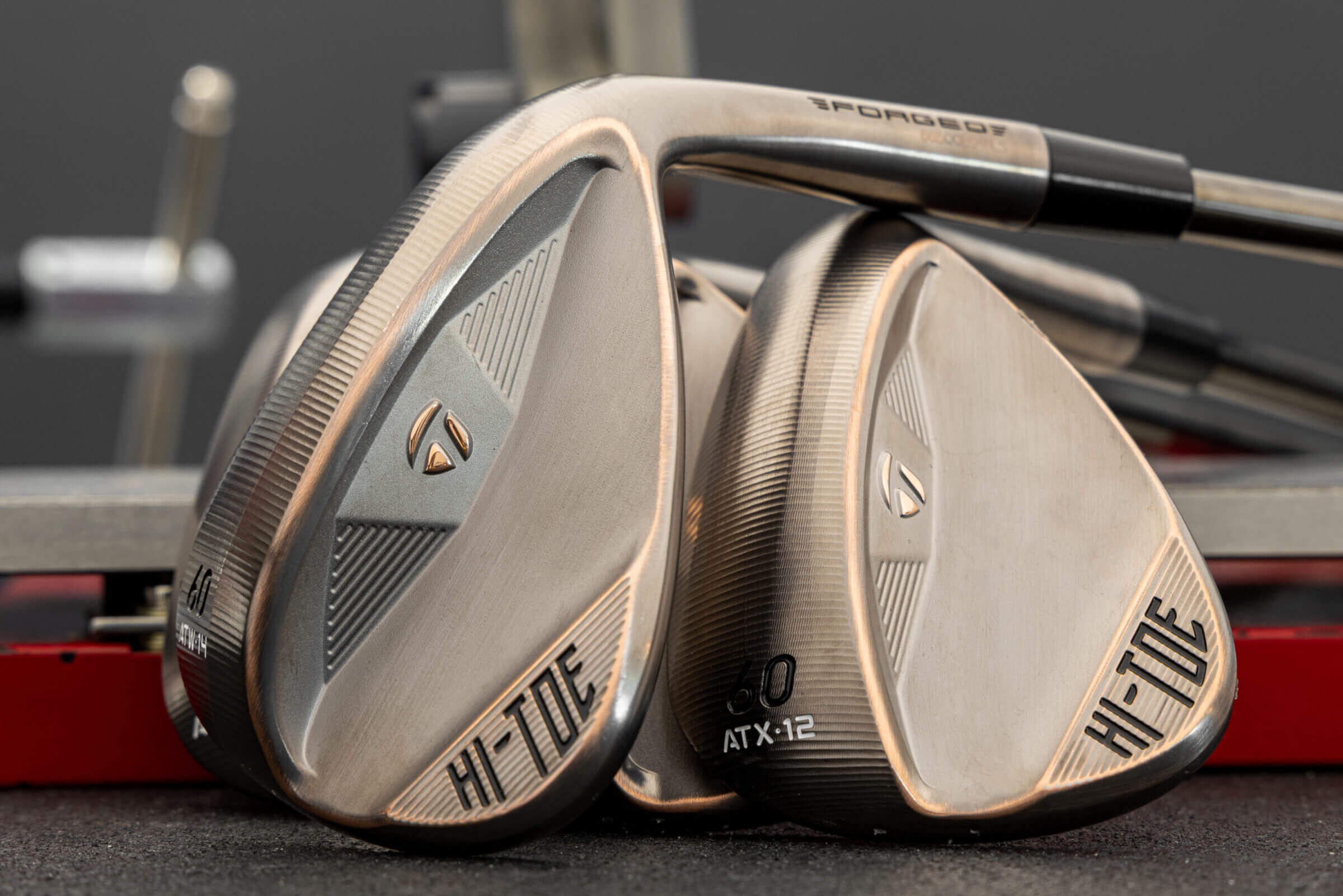
Cutting a forging die for a wedge head with an expanded toe profile is not the same job as cutting one for a conventional teardrop shape. The extra mass out toward the toe has to flow into the die, the grind windows are asymmetric, and the volume across five sole options and eleven lofts does not amortize the tooling quickly. TaylorMade did it anyway, and kept the price at $199.
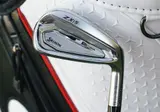
Hi-Toe 5 arrives Sept. 3 as the fifth generation of a shape TaylorMade launched in 2017 with Justin Rose, and the first one forged. That completes a fully forged wedge family alongside MG5. The line carries the saw-milled grooves TaylorMade introduced on MG5 last year, tighter tolerances and steeper walls aimed at the USGA ceiling, plus the Spin Tread laser-etched micro-channels that first appeared in 2023. Stock steel is a blacked-out 115-gram KBS Hi-Rev 2.0, stock graphite is the 80-gram UST Recoil DART, and everything ships in Aged Copper unless you go through the custom department.
The more interesting part of this launch is what it says about a feature TaylorMade no longer owns. In 2017, full-face grooves and a raised toe were a genuine point of difference. They are now a category checkbox. Cleveland built RTX Full Face into a standing line. Callaway ran Jaws Full Toe before folding the geometry into its main wedge program. Ping has been selling variations on a high-toe profile since the Eye2, which is to say since before most of the current wedge buying public was born. When a differentiating feature gets copied by every competitor within a product cycle or two, the brand that started it has two options: defend on price or move the argument somewhere the copiers cannot follow quickly. Forging and a five-grind matrix is the second option.
The grind lineup is also an inventory document. ATS spans 50 through 60 degrees and runs left and right handed. ATV and ATX cover 58 and 60 in both hands. ATW, the high-bounce option, is right handed only. ATC, the low-bounce split sole, is right handed only and custom order only. That is a company that remembers what wedge SKU bloat did to retail shelves in the mid-2010s, when specialty grinds sat in bins until they got marked down to $89 and taught the customer to wait for the markdown. Pushing the narrowest grind entirely into custom order means it never becomes dead stock. Left-handed players get three grinds and are presumably used to it by now.
The margin story sits in the MyHi-Toe 5 configurator. Stock is $199. Personalized, with Tour Raw or Charcoal Black finishes, stamped text, one of fifty-plus icons, custom ferrules and fifteen paint fill colors, it is $249.99. That is a 25 percent uplift on a product whose underlying manufacturing cost barely moves, sold direct, with no retailer taking a cut and no inventory built before the order lands. Titleist proved the model with WedgeWorks and has been quietly harvesting it for a decade. The wedge is the ideal object for it: small, personal, replaced more often than an iron set, and the one club a golfer is willing to treat as jewelry.
TaylorMade sits second globally in the DORMIED Index at 81.7, down 18.3 percent month over month, which is what a June looks like when the driver cycle has already been spent and the wedge launch has not shipped yet. Hi-Toe 5 will not reverse that on its own. What it will do is tell you whether TaylorMade still believes in retail for its specialty line or has decided the configurator is the store. Watch the shelf presence at Golf Galaxy and PGA Tour Superstore in September. If Hi-Toe 5 shows up as one facing of ATS 56 and 60 while everything else lives online at $249.99, that is not a merchandising accident. That is the plan.