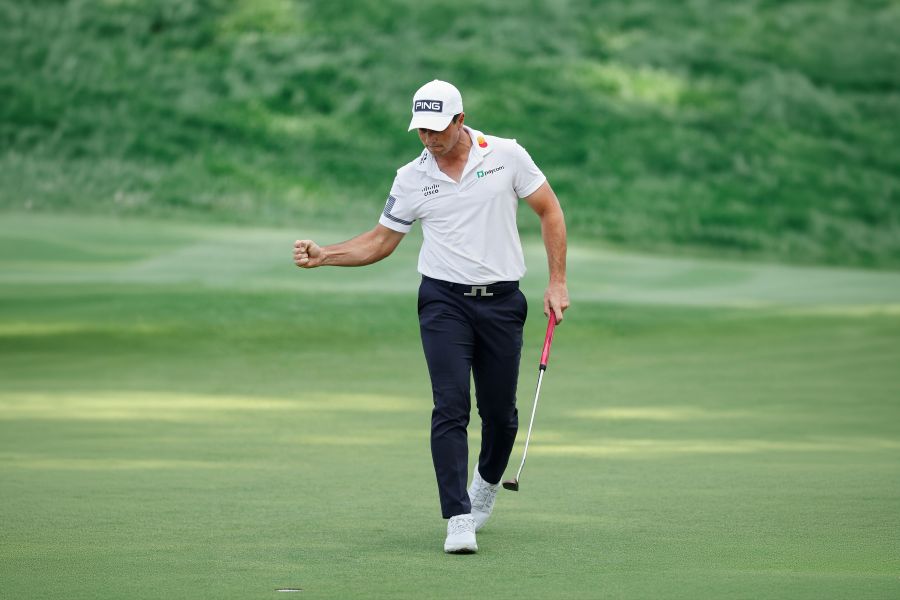
Winning the Travelers in a Monday playoff over the world number one is the kind of tour result apparel brands write six-figure ambassador checks hoping for. J.Lindeberg got it from Viktor Hovland this week, and it landed inside a 30-day stretch that also included the brand's 30-year anniversary capsule and a U.S. Open showing from two of its ambassadors.
What Did Viktor Hovland Wear at the Travelers Championship?
Hovland closed out the win in the Heath Polo, a lightweight piece that is exactly what it looks like: a clean, unfussy shirt built to disappear on television and photograph well in the trophy shot. Over four rounds he cycled through the Tucker, Viggo, Bala Print, and Tour Tech Print, with the Mitch Pant in three colorways before switching to the white Ellott on Sunday. That is a full-catalog rotation staged across one tournament week, and it read that way. The Viggo, with its cut-and-sewn Bridge panel and mesh back, is the technical piece in the lineup and the one that will do the most work for J.L's fall wholesale story.
The context around the win is where the story gets more interesting. J.Lindeberg's 30-year capsule honoring Jesper Parnevik, the brand's original ambassador, is a smart piece of heritage marketing at a moment when every apparel brand in golf is trying to manufacture a founding myth. Parnevik wearing J.L. in the late nineties is one of the actual origin stories in golf apparel, right alongside Tiger and Nike. Leaning into it makes sense. Whether the modern J.L. customer, who is more likely to buy in Copenhagen or Shanghai than at a U.S. green grass shop, cares about Parnevik is a separate question.
Why Isn't the Tour Win Lifting J.Lindeberg?
Which brings up the harder part. J.Lindeberg sits at #18 in the DORMIED global ranking this month, which is respectable, but the trend line is down 18.2% month-over-month. That is a meaningful drop for a brand in the middle of its biggest anniversary push and coming off a tour win. It suggests the brand's cultural share of voice in golf specifically, as opposed to its broader lifestyle presence across those 2,000 wholesale doors, is thinner than the press release implies. J.L. has always been a fashion brand that plays in golf, not a golf brand that dabbles in fashion, and that positioning cuts both ways. It gives them credibility on the design side that most competitors cannot fake. It also means golf-first buyers default to Malbon, Bogey Boys, or the resurgent legacy names when they want something with attitude.
The Hovland relationship is the most valuable asset in J.L's golf portfolio, and it has been since 2019. He is 27, plays a schedule that keeps him on U.S. broadcasts, and now has eight wins and a Ryder Cup pedigree. If J.L. wants to convert its European lifestyle presence into American golf shelf space, Hovland is the mechanism. The question is whether the brand is willing to invest in the U.S. retail infrastructure to capitalize on the airtime. Right now the answer looks like partially. The jlindebergusa.com split site is functional but not aggressive, and the brand's presence in serious American green grass accounts is spottier than its European footprint suggests it should be.
What Is J.Lindeberg's U.S. Retail Problem?
Expect a fall push built around Hovland, the Parnevik capsule, and a broader attempt to reintroduce J.L. to a U.S. golf audience that knows the name but has not necessarily bought the shirt. If the down trend reverses in the next two months, the anniversary campaign worked. If it doesn't, J.L. has a tour star problem in reverse: the ambassador is winning, and the brand still cannot quite convert it.