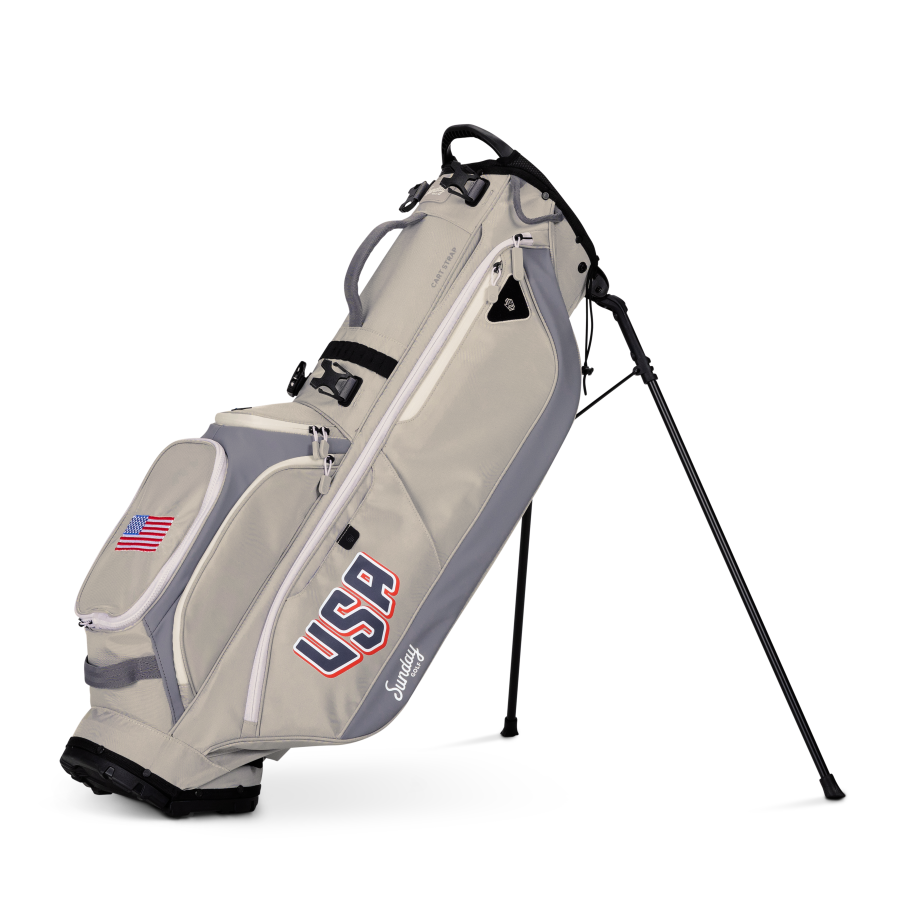
Tying a golf bag drop to soccer's biggest event is the kind of marketing move that only makes sense if you've already accepted that your customer doesn't live inside the golf bubble.
What Does The World Cup Golf Bag Include?
Sunday Golf released a limited run of World Cup-inspired Ryder stand bags this week, eleven country editions in total: USA, Canada, England, Mexico, Brazil, Spain, Korea, Japan, France, Argentina, and Ireland. Each bag carries an embroidered national flag on the ball pocket and the country's federation crest pressed onto the apparel pocket. Retail is $264.99, web-exclusive, while supplies last. The underlying product is the standard Ryder: 5.5 pounds, 5-way full-length divider top, insulated frosty pocket, velour-lined valuables pocket, smell-proof pocket, lifetime warranty.
The choice of the Ryder rather than the lighter Loma or the larger Ranger is the right one. The Ryder sits in Sunday's sweet spot, light enough to walk with, structured enough to ride, priced where a casual second bag becomes an impulse buy rather than a household conversation. Eleven SKUs is also a tell. This is not a country-by-country licensing exercise with FIFA, which would have been a longer, more expensive process and would not have included Ireland, who failed to qualify. It is a flag-and-crest treatment on an existing chassis, which is how you move a capsule quickly without dragging legal through a six-month negotiation.
Why Is Sunday Golf Chasing Soccer Fans?
The broader move makes sense in context. Sunday Golf has spent the last four years building a brand that treats golf bags the way streetwear treats hoodies, a base silhouette refreshed with collabs and drops. The 7-Eleven and Whataburger bags were the proof of concept. Both were unserious on the surface and quietly effective at putting Sunday in front of consumers who do not read GolfWRX. The World Cup capsule is the same playbook scaled to a global event, and it lands in a month where Sunday's DORMIED Index trend is up 49.1 percent, the kind of jump that usually follows a real product win. The Ranger picking up MyGolfSpy's 2026 Staff Pick for Stand Bag of the Year is doing some of that work.
What makes this drop notable for the category is the audience math. Soccer in the United States skews younger, more urban, and more multicultural than the traditional golf customer. The Mexico and Argentina bags are not aimed at the country club locker room. They are aimed at the 28-year-old who plays muni golf in a soccer jersey and would happily carry a bag that signals which World Cup he's watching at the bar after his round. Vessel does not make this bag. Sun Mountain does not make this bag. Ping certainly does not make this bag. That space, the cultural-merch end of the golf bag market, is one Sunday has effectively claimed by being the only major bag brand willing to treat its product like apparel.
Can Sunday Golf Keep Its Drop Strategy Working?
The risk in capsule-heavy strategies is dilution. Drop too often, and the customer waits for the next one instead of buying the current one. Sunday has been disciplined so far, picking partners that are either regionally beloved (Whataburger) or culturally ubiquitous (7-Eleven), and the World Cup fits cleanly into that framework without cannibalizing the core lineup. The lifetime warranty also quietly does work here. A novelty bag becomes less novel when the buyer knows it'll outlast the tournament cycle by a decade.
The interesting question is what 2026 looks like after the World Cup wraps. Sunday has effectively built a calendar brand, where every cultural moment is an opportunity for a drop, and the bag is the canvas. If the next move is Olympics-themed, or a Copa America follow-up, or a college football capsule for the playoff, the strategy is no longer about golf bags. It is about being the first golf brand to operate like a lifestyle label. That is a bigger market than 5-way dividers.