A production run of 70 to 80 units does not exist to generate revenue. It exists to generate a reason to talk, and Toulon Golf has now spent four months talking.
What Is the Toulon Golf Coastal California Series?
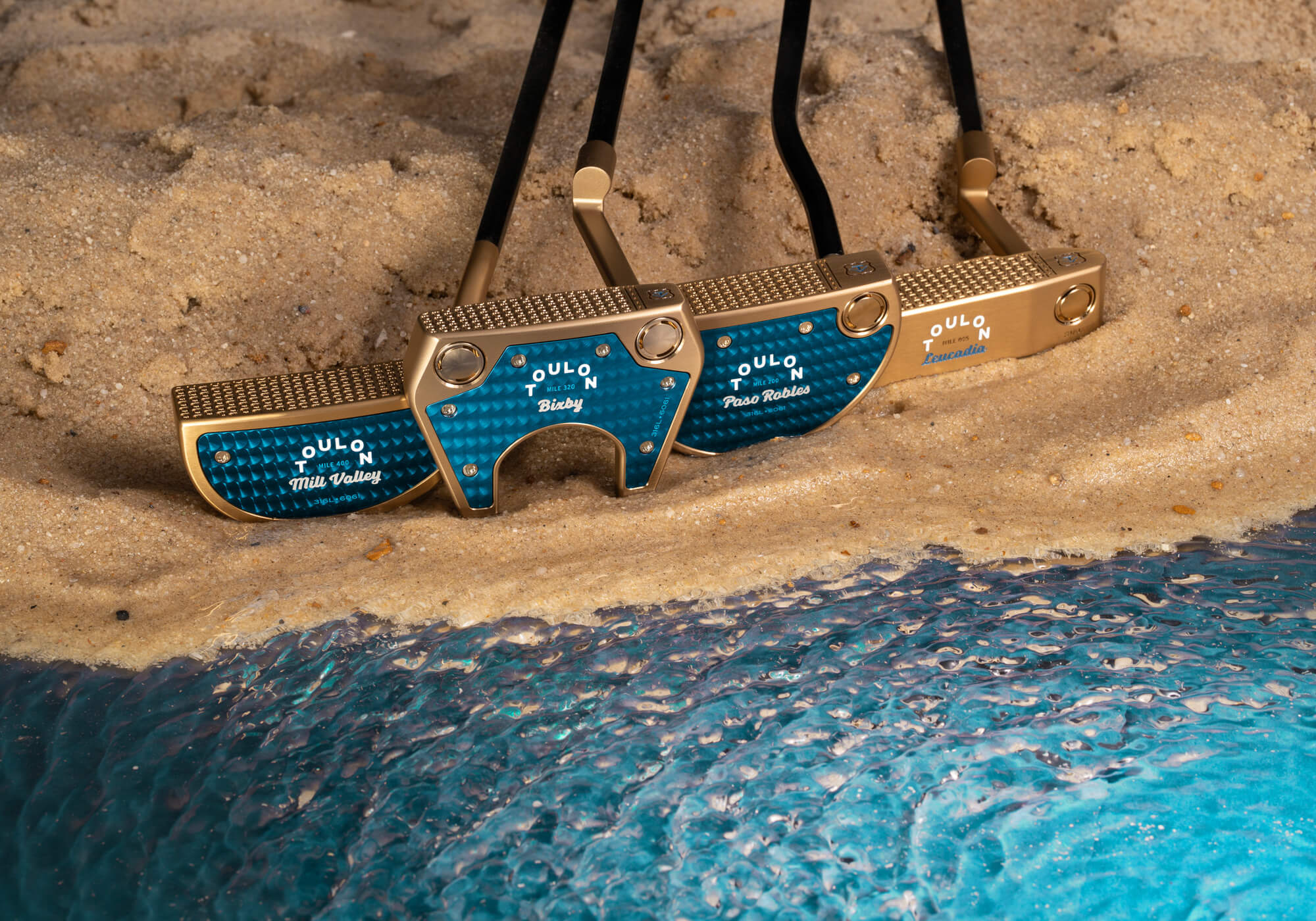
The Coastal California Series closed this week with the Mill Valley, a heel-shafted half-mallet finished in Golden Sand PVD with Ocean Blue paintfill and a machined sole plate, priced at $700. It follows Leucadia, Paso Robles and Bixby, each tied to a stop on a Highway 1 itinerary and each a different head shape. Total production across all four models is roughly 300 putters. Individual models land in the 70 to 80 range. Everything sells through ToulonGolf.com.
Run the arithmetic and the strategic logic gets clear fast. Three hundred putters at $700 grosses about $210,000 before cost of goods. That is a rounding error inside Topgolf Callaway's equipment business, and Toulon has been inside that business since Callaway acquired Sean Toulon's company in 2016 and slotted it above Odyssey's mainline milled offerings. The Coastal California Series is not a revenue line. It is a brand-maintenance program with a shipping component.
What Are the Four Toulon Coastal California Series Putters?
Each of the four came out on its own day, all in Golden Sand PVD with Ocean Blue paintfill and a face milling pattern taken from California highway signs.
The Leucadia
The first release and the only blade: a tri-soled Anser shape with a smooth-edged plumber's neck and 45 degrees of toe hang.
The Paso Robles
A 360-gram round mallet with a double-bend hosel and full face balance. It introduced the series' sole plate, a three-piece assembly built around a wafer-thin sheet etched flat with a classic-car dashboard pattern, then molded with two more layers into the curve a sole needs. The etching machines only work on flat stock, which is why the layering exists, and Toulon says the process may be too costly to reach a stock line.
The Bixby
Named for the 1932 Bixby Creek Bridge on Highway 1 south of Carmel rather than a town, it is a 365-gram version of Toulon's Las Vegas head with the same three-layer sole. Its extended plumber's neck strips out most of the toe hang the shape would normally carry, so it looks like a slight-arc blade at address and rotates closer to face-balanced.
The Mill Valley
The last stop: a $700 heel-shafted half-mallet with a machined sole plate.
Why Does Toulon Golf Price Above Odyssey Milled Putters?
The more interesting detail is the price shelf. Odyssey's premium milled models sit in the $400 to $500 range. True boutique, meaning Cameron Circle T, Bettinardi tour stock, the Japanese forgers, starts north of $1,000 and often much further north. Seven hundred dollars is the gap in between, and it is a gap Odyssey cannot occupy under its own badge without eating its own Ai-One Milled sales. Toulon exists to stand in that gap. That is the actual function of the sub-brand, and it explains why the releases are small, sequential and web-only rather than stocked at Golf Galaxy.
The design borrows openly. Flip the Mill Valley over and the outline, the flowing hosel and the toe-heavy asymmetry read as an Odyssey #9, one of the most durable head shapes in the parent company's catalog. Flip it back and the rear flange falls away visually, leaving a thin topline and a single sight dot that address like a blade. Borrowing from the corporate parts bin is not a sin. Scotty Cameron has been reissuing the Newport for a quarter century. But it is worth naming what is happening: a premium sub-brand charging a $200 premium over Odyssey milled, on a silhouette Odyssey already owns, with the differentiation living in finish, machining and the story attached to the drop.
How Do Limited Edition Milled Putters Build an Audience?
The story is doing real work here. Bettinardi built the Hive around exactly this mechanic, members-only drops with a narrative and a number attached, and turned scarcity into a recurring audience rather than a one-time transaction. Toulon is running the same play without the membership infrastructure underneath it. Each drop got its own editorial post, each post accumulated an audience for the next one, and the series ended with a natural cliffhanger about where the next itinerary goes. What Toulon does not appear to have built is the list. Four sequential sellouts should produce a waitlist that makes the fifth release faster and the sixth one automatic.
Whether any of it registers at scale is a separate question. Toulon sits 93rd of 215 brands in DORMIED's global rankings, flat month over month, which is roughly what a 300-unit run should be expected to move: nothing. That is not a failure. It is a scale mismatch between the tactic and the measurement.
The thing to watch is what Toulon does with the audience it just spent four months assembling. A second itinerary that runs the identical format will read as a series. A second itinerary with a registration gate, allocation rules and a collector's channel behind it would read as a business. Callaway has the customer data infrastructure to build the second version. Toulon has now proven there is demand worth building it for.