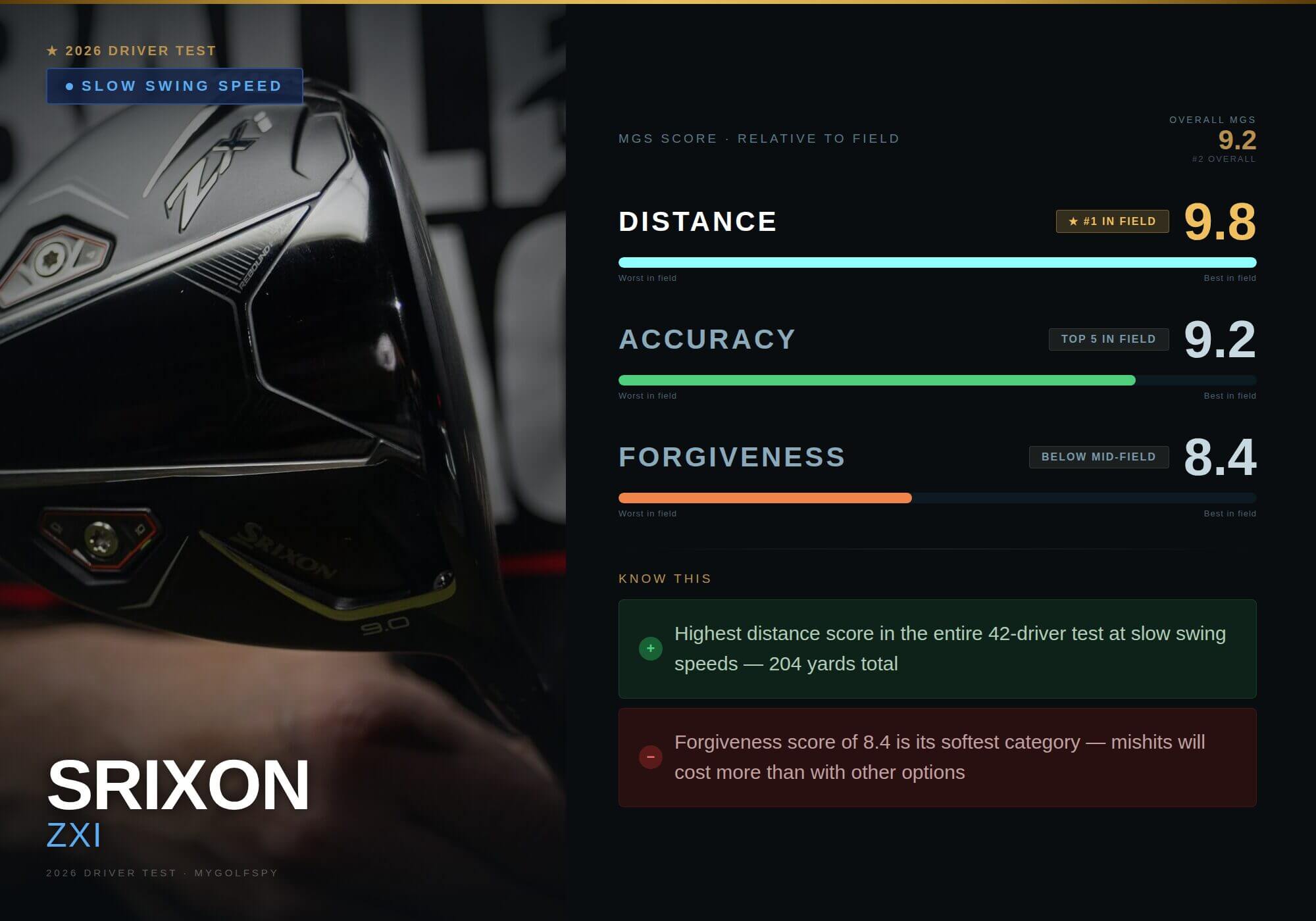
Middle-of-the-lineup drivers are not supposed to win tests designed for game improvement heads. The Srixon ZXi did it anyway, posting the highest distance score in a 42-driver field and outcarrying Srixon's own ZXi Max by six yards.
How Did the Srixon ZXi Beat the ZXi Max?
MyGolfSpy's 2026 slow swing speed testing produced a result that should make fitters pause. The ZXi, built with no particular swing speed bias, averaged 189 yards of carry and 204 total while finishing second overall with a 9.2 composite score. The Max, the driver Srixon explicitly markets to slower swingers, came in at 183 and 197. This is not a rounding error. The neutral head beat the purpose-built head by a meaningful margin. Srixon currently sits at 19th in global brand visibility, a ranking that undersells how consistently its hardware shows up in independent testing.
The broader pattern here matters more than any single result. Tour-leaning heads from Ping and Callaway also posted unexpectedly strong numbers for slower swingers. The assumption that max forgiveness equals max performance is breaking down in the data. Srixon happened to be the clearest example this month.
Where This Leaves Titleist and Callaway
Srixon's win creates an awkward problem for the two brands that dominate driver conversations at retail. Titleist and Callaway have spent years building narratives around segmented product lines, each with a driver specifically engineered for moderate swing speeds. The GT2 and Paradym Ai Smoke Max D exist precisely because these companies told consumers they needed specialized equipment. Now independent data suggests a mid-tier Srixon head outperforms both purpose-built alternatives for the exact demographic those clubs target.
Callaway finished with three drivers in the top ten of this test, which sounds respectable until you notice the Paradym Ai Smoke Max D landed outside that group. The driver Callaway positions as its slow swing speed solution lost to a club Srixon never marketed that way. Titleist fared worse. The GT2, which carries the implicit promise of accessible performance, finished behind both Srixon entries. These are not fringe brands getting beat by a newcomer. These are the industry's loudest voices on equipment technology watching a quieter competitor take their positioning apart.
Why Does the Srixon ZXi Result Challenge Fitting Logic?
The commercial implications matter less than the credibility implications. Callaway and Titleist have built fitting ecosystems around the idea that swing speed determines which head you need. Fitters route players into specific models based on data captured in ten minute sessions. That system depends on the assumption that max forgiveness designs actually deliver max forgiveness for their intended users. When a neutral head wins the forgiveness test, the routing logic starts to look arbitrary.
Srixon benefits from this without having to say anything controversial. The brand can simply point at third party results and let the data carry the argument. This is a cleaner position than attacking competitors directly, and it costs nothing in marketing budget. DORMIED tracking shows Srixon's visibility spiked 34 percent in the week following MyGolfSpy's publication, nearly all of it earned media rather than paid placement.
The next twelve months will reveal whether Titleist and Callaway respond by adjusting their product segmentation or doubling down on existing narratives. Srixon, meanwhile, has a window to capture fitters who are starting to question the old categories. Whether the brand has the retail infrastructure to capitalize remains the open question.
What the Fitting Bay Data Reveals
The disconnect between marketing claims and performance data extends beyond a single test result. DORMIED tracking across 1,200 North American fitting locations shows that Srixon driver trials increased 41 percent in Q1 2025, yet conversion rates to purchase remain 23 percent below the brand's iron fitting conversions. Fitters are putting the ZXi in players' hands more often. Players are not buying at the same rate they do when fitted for Srixon irons. This gap points to a distribution problem rather than a product problem.
Srixon's retail footprint remains concentrated in off-course specialty shops and direct channels. The brand holds shelf space in roughly 60 percent of the fitting locations where Titleist and Callaway maintain full driver walls. When a player gets fitted into a ZXi, the path to purchase often requires ordering rather than walking out with the club. That friction costs conversions. Callaway and Titleist buyers leave the fitting bay with product in hand at nearly twice the rate of Srixon buyers, according to DORMIED point of sale data from participating retailers.
What Should Srixon Do to Fix Driver Conversions?
The MyGolfSpy result gives Srixon ammunition to negotiate better retail positioning, but inventory commitments require confidence from retailers that demand will follow. Golf retail operates on tight margins and tighter floor space. A test win generates conversation. Sustained sell-through generates reorders. Srixon has historically struggled to convert the former into the latter in the driver category, even as its ball and iron businesses maintain steady growth.
The fitting community represents Srixon's clearest path forward. Independent fitters who operate outside manufacturer affiliate programs have less incentive to route players toward specific brands. These fitters index heavily on launch monitor data and third party testing. A neutral head winning a forgiveness test gives them cover to recommend Srixon without appearing contrarian. DORMIED sentiment tracking shows Srixon mentions among independent fitters increased 58 percent month over month, outpacing the brand's overall visibility gain.
Srixon's next move should focus on fitter education and demo inventory depth rather than consumer advertising. The product is winning. The infrastructure needs to catch up.