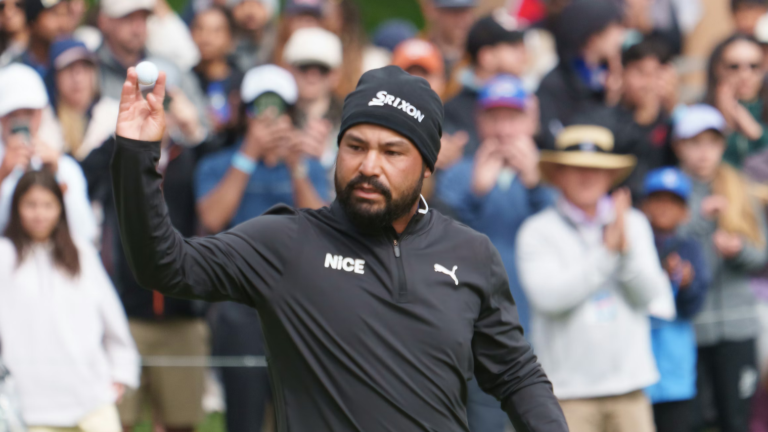
A final-round 67 at TPC San Antonio delivered J.J. Spaun his third PGA Tour victory and gave Puma Golf a narrative it can actually build around.
Spaun's one-shot win over Robert MacIntyre, Matt Wallace, and Michael Kim came in brutal conditions: gusting winds, wet turf, and the kind of unpredictable footing that makes equipment choice matter. The defining moment arrived at the drivable par-4 17th, where Spaun trusted a driver off the tee, recalled his U.S. Open mentality from Oakmont, and buried an eagle putt to take the lead for good. For Puma, the timing could not be better. The brand sits at 37th globally with a modest visibility score, though month-over-month momentum has spiked 50 percent. Tour wins from sponsored athletes remain the most efficient path to cultural relevance in golf apparel, and Spaun, now a major champion with back-to-back signature moments, gives Puma a credible face for its performance footwear push.
The question now is whether Puma can translate Spaun's form into sustained brand heat or whether this becomes another isolated win that fades from memory by the next major. With Spaun trending toward Ryder Cup consideration and sitting inside the world top 10, the opportunity is there. Puma just has to execute off the course as well as Spaun did on it.
Where Puma Sits in the Footwear Fight
Puma Golf's competitive position in performance footwear remains precarious despite Spaun's victory. The brand competes in a category dominated by FootJoy's tour saturation and Nike's cultural cachet, while newer entrants like G/FORE and True Linkswear chip away at the lifestyle segment. Puma occupies an awkward middle ground: too performance-focused to win style points, not visible enough on tour to claim technical credibility. Spaun's win addresses the second problem but does nothing for the first.
The footwear math on the PGA Tour favors volume. FootJoy sponsors roughly 40 percent of the field in any given week. Adidas, despite pulling back from golf apparel, maintains meaningful footwear presence. Nike continues to benefit from Tiger Woods' decades of dominance and a roster that includes Rory McIlroy and Scottie Scheffler. Puma's footwear count hovers in the single digits most weeks. One athlete winning, even winning consistently, cannot overcome that structural disadvantage in brand recall.
DORMIED data suggests Puma's visibility spikes correlate almost exclusively with Rickie Fowler and now Spaun. The brand lacks the distributed presence that converts casual viewers into customers. When Fowler misses cuts or fades on Sunday, Puma disappears from broadcasts. Spaun's emergence provides a second pillar, but two athletes do not constitute a strategy. Contrast this with Adidas, which maintains visibility through volume despite lacking a single dominant face, or FootJoy, which treats tour presence as infrastructure rather than marketing.
The broader industry context matters here. Golf footwear sits at an inflection point where performance and lifestyle increasingly converge. Players want spikeless options that work at the course and the airport. Brands that crack this code, G/FORE with its bold aesthetics, Nike with its crossover appeal, capture wallet share from golfers who buy multiple pairs. Puma's Ignite line performs well in reviews but lacks the visual distinctiveness that drives social sharing or the tour validation that drives serious player adoption.
Spaun's win gives Puma content for a campaign cycle. Whether it translates to market share depends on whether the brand can sign two or three more credible tour players before the momentum fades. The window is narrow. Spaun's form will not last forever, and the footwear category moves faster than Puma's current roster can carry it.
The Fowler Problem Still Looms
Puma's relationship with Rickie Fowler remains the elephant in every strategic conversation about the brand's golf future. Fowler signed his initial deal in 2016, and for years he delivered exactly what Puma needed: top-ten finishes, major contention, and a social media presence that moved product. But Fowler's competitive decline between 2020 and 2023 exposed how dangerously dependent Puma had become on a single athlete. When Fowler missed the FedEx Cup playoffs in consecutive seasons, Puma's tour visibility collapsed.
Fowler's resurgence in 2023, including his runner-up at the U.S. Open, temporarily solved the problem. Now Spaun's emergence creates something Puma has not had in years: redundancy. But redundancy is not the same as depth. DORMIED tracking shows that Fowler and Spaun combined still generate less broadcast exposure than FootJoy's tenth most visible athlete. The structural gap remains enormous.
The Fowler contract reportedly runs through 2026, and its size likely constrains Puma's ability to pursue additional marquee signings. This is the trap many mid-tier golf brands fall into. They secure one expensive face, build campaigns around that athlete, then lack the budget to develop supporting roster depth. When the star struggles, the brand struggles. Callaway escaped this pattern by spreading investment across multiple tiers. Titleist treats tour presence as a technical validation exercise rather than a marketing platform. Puma has tried to split the difference and ended up with neither approach's advantages.
Spaun's contract details remain undisclosed, but his trajectory suggests a renegotiation window approaches. Puma faces a choice: pay market rate to lock in a proven winner or risk losing him to a competitor flush with budget. TaylorMade, now backed by private equity, has shown willingness to spend aggressively on rising talent. Adidas, despite its apparel exit, maintains footwear ambitions that could include athlete acquisition.
The smartest move for Puma involves using the Spaun momentum to sign two or three emerging Korn Ferry players at modest rates. Build the farm system before the current stars fade. The brand has perhaps eighteen months before this window closes.