Premium launch monitor hardware has been converging for three years. Radar or camera, the good units all report ball speed, spin axis and club path inside tolerances no amateur will ever detect. What differentiates them now is what happens to the numbers after the shot lands, and that is a software problem, not a sensor problem.
What Does the Full Swing Simulator App Update Add?
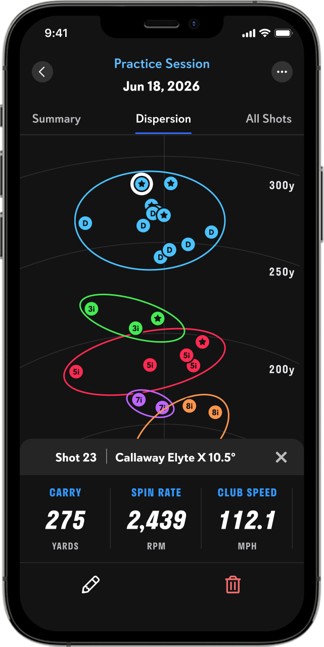
Full Swing's new release is an answer to that problem. The company has connected its mobile app directly to its simulator software, so any player logged into the Full Swing Launcher gets automatic syncing of range sessions and completed rounds to an app profile. Range sessions push dispersion charts, accuracy plots, club usage and shot history the moment they end, sharable to a coach in two taps. Completed rounds populate an Activity Feed with scorecard, tee selection, driving distance, GIR, putting and scrambling numbers. Users can build a digital bag with their actual clubs, custom names and colors, which loads automatically into every range session. Skill Strike gets a rotation mode for group play, three shots per player, and Victory Ranch, the Rees Jones design running over 7,600 yards through the mountains at Heber City, joins the course library.
The feature list matters less than the timing. Versant Media Group closed its acquisition of Full Swing weeks ago, and the first release under new ownership is not a hardware refresh. It is an account system. Versant already owns Golf Channel, GolfNow and GolfPass, which means it owns tee time inventory, a subscription video business and now a simulator install base that includes the PGA TOUR license and TGL technology partnership. An app that automatically knows what course you played, what you scored, which clubs are in your bag and where your 7-iron misses is not a practice tool. It is a customer profile with a golf swing attached.
Which Brands Built Software Moats Before Full Swing?
The precedent is Cobra Connect in 2016. Cobra put Arccos sensors in every grip and turned a one-time club sale into a recurring data relationship, and the interesting part was never the strokes gained dashboard. It was that Cobra suddenly knew what its customers actually did with the clubs. Trackman ran a version of the same play from the other direction, building Trackman Golf and range licensing on top of a hardware business so the box became the cheapest part of the relationship. Toptracer scaled by licensing software into ranges it did not own. Full Swing is arriving late to this structural idea but with an unusual asset: a parent company that also sells the tee time and the instruction video.
On its own merits, the update is catch-up rather than leap. Arccos and Garmin have shipped automatic round tracking, club-by-club dispersion and shared coach reports for years. Shot tracer controls with ten recent shots per club, clear-all warm-up shots and a simplified KIT-to-simulator toggle are housekeeping items, the kind of thing that appears in release notes when a product team finally gets budget. The course library race is one Foresight and the GSPro modding community fight far harder than Full Swing does, and one Rees Jones addition does not change that math. The genuinely sticky piece is the digital bag, because a profile a customer spends time building is a profile a customer does not rebuild inside a competitor's software.
Is Full Swing Building an Account Layer, Not Hardware?
What to watch is the connective tissue nobody announced. There is no GolfNow or GolfPass integration in this release, which is precisely why it is worth flagging. A range session that syncs and shares with a coach sits one product decision away from a paid lesson funnel, and an Activity Feed of completed rounds sits one decision away from a tee time recommendation. Full Swing still ranks #122 of 215 on the DORMIED Index, and its 20.8 percent monthly move comes off a very small base, which is what a hardware brand with almost no consumer-facing software surface looks like in the data. Versant bought a simulator company and immediately started building an account layer. The hardware is not the product anymore, and the next release will make that explicit.