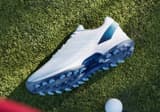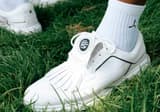

Nobody buys a golf shoe for the spikes. But the spikes are the only part of the shoe that ever gets replaced, which makes them the only recurring revenue line in golf footwear. That is a smaller business than the shoe and a much better one, and it explains why a cleat brand issues a press release when a shoe brand wins a tournament.
The news: the Omega European Masters champion closed at Crans-sur-Sierre with an eight-under 62 from six shots back, posted 18 under, watched the lead change hands late, made bogey on the 72nd hole, then won on the fourth playoff hole. It was a second consecutive title at Crans and a third overall, following 2022 and 2025, which puts him alongside Seve Ballesteros as the only player since 1972 to win the Swiss event three times. The shoes were FootJoy. The spikes were Softspikes Pulsar.
Two brands, one win, and only one of them needed the credit. FootJoy is already ranked sixth of 215 brands in the DORMIED Index and did not move a tick month over month, because a DP World Tour win in FootJoy footwear is roughly as newsworthy as rain in Wales. Softspikes, manufactured by PrideSports and founded in 1993 after a winter metal-spike ban pushed by several state golf associations, is a component brand. Component brands live inside other people's products, and the only marketing lever available to them is the receipt: whose shoe, whose win, whose sole plate.
The complication is that FootJoy's retail business has been drifting away from the thing Softspikes sells. Spikeless has taken over the floor because the amateur wants one shoe that works on the range, in the cart and at the bar afterwards, and a spikeless outsole has no replaceable parts. Cleated footwear is now the high-signal, low-volume end of the line: tour staffers, traditionalists, the guy who plays in the rain in February. Softspikes calling itself the number one spike on the PGA Tour is accurate and also a narrowing claim, because tour is one of the last places where replaceable traction is close to unanimous.
Which is why the most commercially interesting sentence in the release is the one about replacing spikes every 15 rounds. That is not a tour message, it is a consumable-education message, and it is the same fight Golf Pride has been having with regripping for two decades. Golfers accept the logic and ignore the calendar. Tour players swap cleats by course condition and turf firmness the way they swap wedge bounce; the club golfer plays the same set of spikes until the receiver breaks. Every round past 15 is revenue that does not happen. A four-hole playoff at Crans is the excuse to raise the subject, not the point of it.
For FootJoy, the arrangement is close to free. Factory-fitted Softspikes traction lets it market outsole geometry, midsole foam and last shape while somebody else pays to advertise the little plastic part. The thing worth watching is whether that holds. Footwear brands have a long history of pulling traction in house once the engineering stops being a differentiator, and FootJoy has both the R&D budget and the tour van access to do it. If that day comes, Softspikes loses the shelf position that makes tour wins tellable in the first place, and a 33-year-old component brand has to find another way to prove it exists. Until then, expect the release every time a FootJoy wins anything.