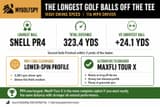

Winning a MyGolfSpy Most Wanted title is supposed to end the discounting conversation, not start it. Mizuno is running a promotion that takes $50 off the JPX ONE Fairway and $30 off the JPX ONE Hybrid, both of which won their 2026 categories outright. Add $150 off JPX ONE drivers and up to $280 off select iron sets and you have a full-bag markdown from a brand that historically protects price better than almost anyone in the category.
The iron discount is the one that gets attention, and it should not be. Mizuno moves irons on reputation built over four decades of Grain Flow Forging in Hiroshima, and a $280 haircut on select sets is what end-of-model-cycle inventory looks like at any OEM. The metalwood discounts are the more interesting number, because they are the ones that shouldn't be necessary. A club that just won independent robot-and-human testing in its category is the definition of a product that should sell itself through the summer at full price.
It doesn't, and the reason is structural rather than technical. Mizuno has never solved metalwood distribution in North America. Walk into most green-grass shops or a big-box wall and count the JPX ONE fairway heads against Callaway, TaylorMade, Titleist and Ping. The ratio hasn't changed much since the MP-600 with the Fast Track sole in 2008, which remains the last Mizuno driver that generated genuine consumer pull in the U.S. Awards create demand. Shelf space converts it. Mizuno has consistently had more of the first than the second, and a discount is the cheapest available substitute for floor presence.
There is precedent for this working. Cleveland spent years using aggressive wedge promotions to buy trial against Vokey's distribution advantage, and it kept the brand in the conversation long enough to build the RTX franchise. There is also precedent for it failing. Nike discounted metalwoods hard in its final two seasons and taught the market to wait for the markdown before it exited the hardware business entirely in 2016. The difference is whether the discount is buying a first-time customer or training an existing one. Mizuno's fairway and hybrid buyer is almost always a first-timer who already owns Mizuno irons, which makes this the good version of the strategy.
The asymmetry in the promotion tells you how Mizuno is thinking about it. The hybrid comes off $30. The irons come off up to $280, roughly nine times as much. A brand protecting its metalwood price integrity while clearing iron inventory is a brand that believes its woods have a future worth defending and its current iron cycle is nearing its end. That is a rational read of both categories, and it is more disciplined than the headline number suggests.
Mizuno sits 23rd of 215 brands in the DORMIED Index this month, flat month over month, which is roughly where a company with elite product credibility and modest commercial reach tends to settle. The brand does not have a product problem. Two Most Wanted wins in metalwoods, the category where Mizuno has the least credibility with American consumers, is the strongest possible evidence of that. What it has is a conversion problem, and conversion problems are solved with retail relationships, fitting-network density and a demo program, not with $30 off a hybrid in July.
Watch what happens to the JPX ONE metalwood price in the fall. If Mizuno holds the line into the next model cycle and pushes the savings back toward irons, this promotion reads as inventory management by a brand that knows exactly what it owns. If the fairway and hybrid discounts deepen, the awards did not move the units, and Mizuno will have confirmed what it has half-known since the MP-600: in metalwoods, winning the test and winning the sale are separate problems.