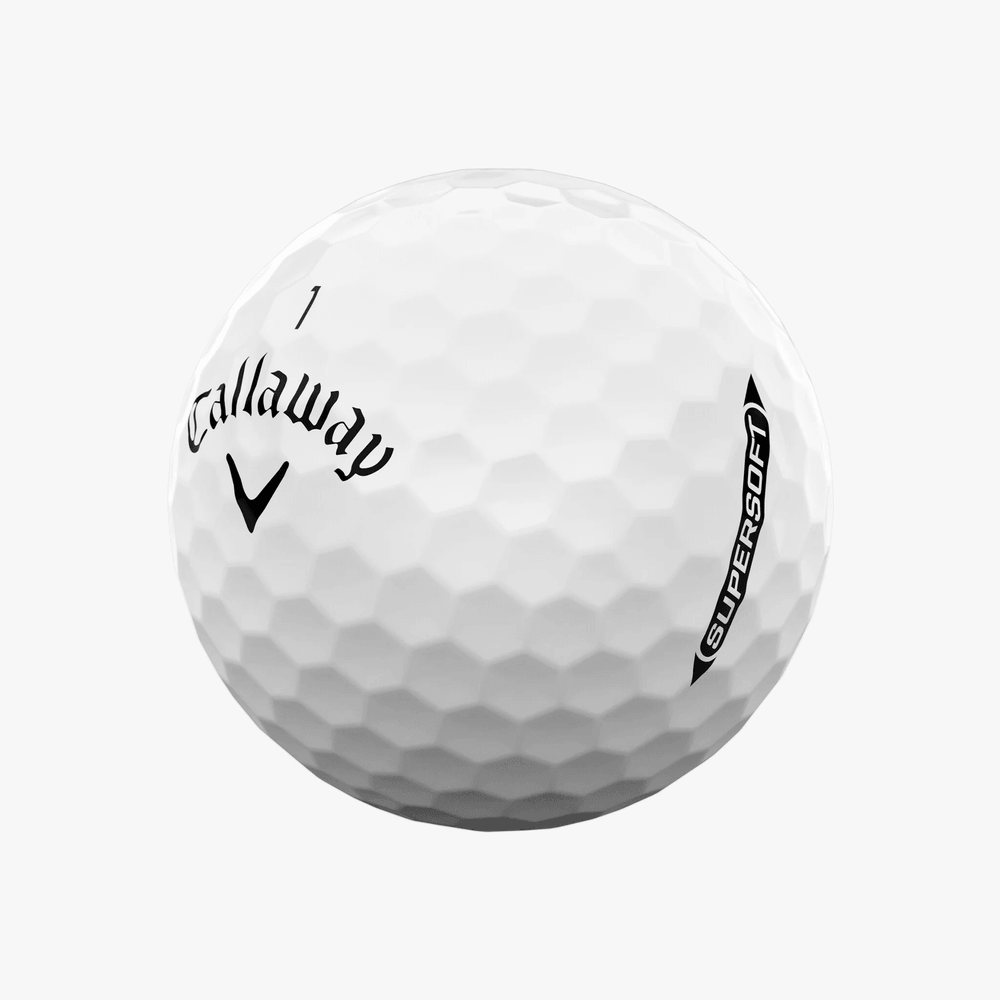
Three boxes, two countries of origin. That line sits quietly in the spec block of MyGolfSpy's Ball Lab teardown of the 2026 Callaway Supersoft: two dozen from Launch Technologies in Taiwan, one dozen from Thailand. For a ball graded on ball-to-ball consistency, sourcing a single test sample from two facilities is not a footnote. It is a substantial part of the explanation.
Why Did the Callaway Supersoft Score a C Grade?
The headline result: a Quality Score of 74, a C grade, and a Not Recommended verdict. Weight and diameter both graded B-minus, every ball cleared the USGA weight limit, and the Good Ball Rate landed at 92 percent with three flagged balls out of 36. What sank it was compression. A 13.5-point delta across the sample, running 40.3 to 53.8, against a database average of 9.7. Compression symmetry averaged 3.0 points of deviation versus a 1.9 field average, the weakest mark on the card. And 32 of 36 balls measured thicker at the seam than at the pole, which is a mold and parting-line signature, not a random scatter.
Some of this is physics rather than negligence. Low-compression ionomer construction is genuinely harder to hold to tolerance than a firm tour-caliber core. Softer core formulations flow differently, cure differently, and are less forgiving of temperature and pressure variance in the press. Wilson learned this with the original Duo in 2011, and Ball Lab has been publishing wide compression spreads on sub-50-compression balls for years. A 44-compression ball is going to be a harder manufacturing target than a 90-compression one. The question is whether the brand names on the box is doing anything to close that gap.
Where Does the Supersoft Sit in Callaway's Ball Lineup?
What makes this interesting from a business angle is where the Supersoft sits inside Callaway's ball portfolio. Callaway bought Top-Flite and the Spalding ball assets in 2003 to acquire domestic manufacturing capacity, then sold Top-Flite to Dick's in 2012 to concentrate resources behind the Callaway name. Chrome Soft launched in 2015 and became the vehicle for the company's serious ball engineering, including the tolerance-controlled tour models made in Chicopee. The Supersoft went a different direction. It is a volume product priced at $26.99 that has moved units for over a decade because the name recognition is enormous and the pitch, softer feel without the tour-ball price, is one of the easiest in golf to understand. Contract manufacturing in Southeast Asia is how you hold that price. A wider tolerance window is the cost of the business model, not an accident inside it.
Here is the fair counterweight. Ball Lab grades on absolute manufacturing consistency, not on consistency-per-dollar, and a golfer swinging 85 mph will lose more distance to a thinned 7-iron than to a four-point compression variance. But that argument cuts against Callaway's own marketing more than it does against the test. The Supersoft is sold on predictability, on being the reliable soft ball for the recreational player. A 13.5-point spread from a ball positioned that way is a claim the manufacturing does not fully support, and Ball Lab exists precisely to check that gap. Callaway sits fourth globally in the DORMIED Index with a flat month, and brand equity that stable is exactly what makes a product like this durable regardless of a C grade. Millions of dozens will still sell.
How Does Callaway's Ball Sourcing Compare to Titleist's?
What to watch is whether Callaway treats this as a spec problem or a supply chain problem. Titleist's answer to the same question was vertical: it owns its ball plants and rarely dual-sources a single SKU. Callaway's answer, at the Supersoft price point, has been to outsource and accept the variance. Neither is wrong. But the company that spent 20 years building credibility as a ball manufacturer is now shipping its highest-volume ball from two contract facilities in two countries, and the test data is starting to make that visible to the people who read test data. That audience is small. It is also the audience that tells everyone else what to buy.