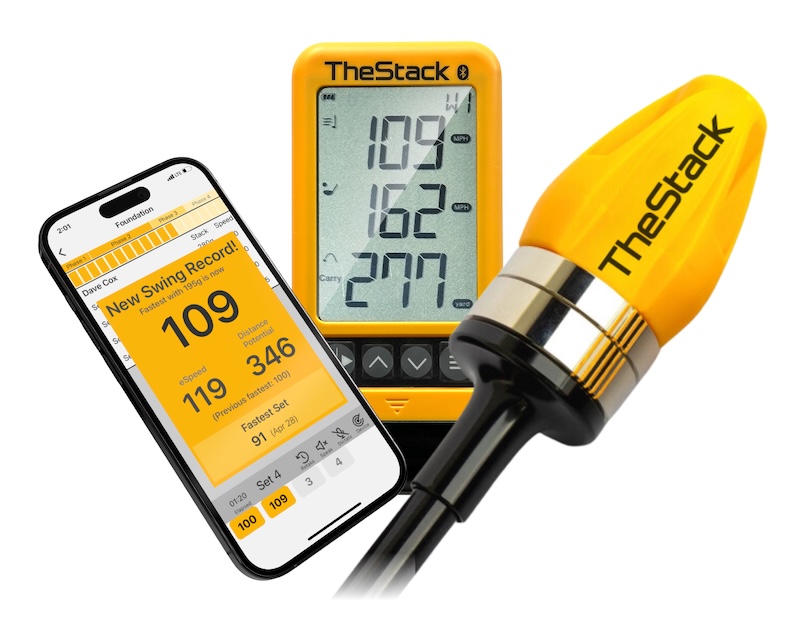
Overspeed training went mainstream in golf around 2015 on the back of a fixed protocol: three sticks, three weights, the same rep scheme for a 15-handicap and a tour winner. SuperSpeed sold enormous volume on that simplicity, and the simplicity was always the weak point. The Stack System was built as the rebuttal, and the number it announced this week is the argument.
The Scottsdale company says golfers have now logged more than 50 million recorded swings on the platform, a figure it is pairing with the quieter and arguably more consequential news at the bottom of the release: speed training is finally available on Android, via web app, after years of iOS exclusivity.
What Makes The Stack's 50 Million Swings Data Different?
Start with the 50 million, because the number is being marketed as scale and its actual value is control. Arccos has hundreds of millions of shots in its database, but they were struck with different clubs, in different wind, off different lies, by golfers with wildly different intent. That data is useful for describing golfers. It is difficult to use for prescribing anything. The Stack's dataset is collected under a narrow set of conditions: one patented club, 30 known weight configurations, prescribed protocols, baseline testing before programming, radar capture on every rep. Sasho MacKenzie spent two decades doing biomechanics work at St. Francis Xavier before this, and the design choice here is a lab choice, not a marketing one. Standardized inputs are what let you run inference on outputs. Fifty million uncontrolled swings would be a press release. Fifty million controlled ones are a moat.
The hardware half of that moat deserves a note too. Marty Jertson is Director of Product Development at PING and co-founded a training company that PING does not sell, which is an unusual arrangement in an industry where OEMs typically absorb or license this kind of IP. Nobody in the big five has shipped a credible speed trainer, and the reason is structural: a training aid is a one-time $350 purchase with a service layer attached, which does not fit a product cycle built on annual driver refreshes. That gap is why the category still belongs to independents.
Why Did the Stack System Android App Take So Long?
Which makes the Android delay the more revealing detail. The Stack launched in 2020 and has spent most of its life addressable only to iPhone owners. Android holds roughly a quarter of the US smartphone market and the clear majority globally, and the company's read on its customer, affluent, American, iOS, was probably correct for the first several years. It is a worse assumption for a brand that now cites college programs and national teams among its users, particularly outside North America. That the fix arrives as a web app rather than a native build is its own signal. It is the cheap version of the fix, and it suggests Android is being served rather than courted.
The brand's flat position near the bottom third of the global index, ranked 164th of 215 with no month-over-month movement, is less a verdict on The Stack than on the category it sits in. Training aids get covered when a tour player is spotted with one and ignored the rest of the year. Milestone announcements do not move brand equity. Distribution does, and Android is distribution.
What Options Does The Stack System Have for Its Data?
What to watch is whether The Stack turns the dataset outward. A company sitting on the largest standardized speed-training archive in golf has a licensing story, an OEM fitting story, and a published-research story available to it, and so far it has mostly used the data internally to refine its own programming. That is the responsible use. It is not the growth use. The next twelve months will show whether The Stack wants to be a training product with good science behind it, or the speed-data layer that everyone else builds on top of.