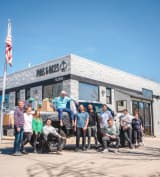
Rental club programs are the unglamorous plumbing of the equipment industry, and 2nd Swing just locked in the most valuable pipe in the system. The Minneapolis-based retailer's renewed role as the PGA of America's Official Golf Club Rental Partner gives it direct access to more than 30,000 PGA Professionals running events at facilities across the country. For TaylorMade, PING, and Callaway, that pipeline is doing work that retail margin alone can't measure.
The mechanics are simple. A PGA Professional fills out a form, 2nd Swing ships sets including bags and accessories, the course returns them after the event. What looks like a logistics service is actually a trial-and-conversion engine for the OEMs whose product fills those bags. Every corporate outing, member-guest, and learning clinic becomes a soft demo day, with the rental brand selection effectively curated by 2nd Swing's inventory mix. The retailer's 150,000-club footprint means TaylorMade, which sits second in the global DORMIED Index this month with a 22.4% month-over-month surge, is overwhelmingly likely to be in the hand of a casual player who has never swung a Qi35.
This is the part of the equipment market that gets undercounted. Demo days at green grass shops produce maybe a few dozen swings per event. A rental program embedded inside the PGA of America's event infrastructure produces tens of thousands of swings per season, in conditions where the golfer cares enough to play but not enough to bring their own bag. That demographic, traveling players, corporate event guests, lapsed golfers returning for one round, is precisely the conversion target OEMs have spent the last decade trying to reach through Instagram ads and Topgolf activations.
2nd Swing's positioning here is more strategic than the press release suggests. The company has spent the past five years quietly building one of the most defensible models in golf retail: a hybrid new-and-used inventory that protects margin in both directions, fitting bays in five major markets, and a trade-in engine that keeps customers cycling through clubs without ever leaving the ecosystem. Adding PGA of America rental fulfillment on top of that gives them a B2B revenue line that competitors like PGA Tour Superstore and Worldwide Golf have not meaningfully entered. The closest comparison is Club Champion's exclusive fitting relationships with select OEMs, except 2nd Swing is operating closer to the consumer touch point. The Dick's Sporting Goods Golf Galaxy acquisition in 2012 was supposed to consolidate this layer of the market. It didn't. 2nd Swing has been the quiet beneficiary.
For TaylorMade specifically, the timing matters. The brand's April surge reflects a Qi35 launch cycle that's running stronger than the Qi10 did at the same point a year ago, and tour validation through Rory, Scottie, and Tommy Fleetwood continues to do its work. But the gap between tour adoption and amateur conversion is where the brand has historically struggled to monetize hype. A rental sleeve at a member-guest in Scottsdale puts a Qi35 in the hands of a 14-handicap who saw the Masters telecast and has been considering a new driver since February. That is not a marketing campaign. That is distribution doing the campaign's job.
The broader read: rental, demo, and trial infrastructure is becoming the next contested layer of the equipment business, and the OEMs that figure out how to influence it without owning it will outperform the ones still pouring budget into tour bag counts that the average buyer cannot identify. 2nd Swing now sits at the center of that infrastructure. Whether TaylorMade, PING, and Callaway treat the partnership as a logistics convenience or as a channel to actively program will separate the brands that grow through this cycle from the ones that simply ride it.