Launch monitor brands do not win college golf with advertising. They win it when one coach with the unit already sitting in the team's short game bay tells another coach it holds up in wind. That conversation happens at maybe a dozen events a year, and there is no media buy that puts you inside it. There is, however, a naming rights line on an awards program.
What Is the Gary Player International Golfer of the Year?
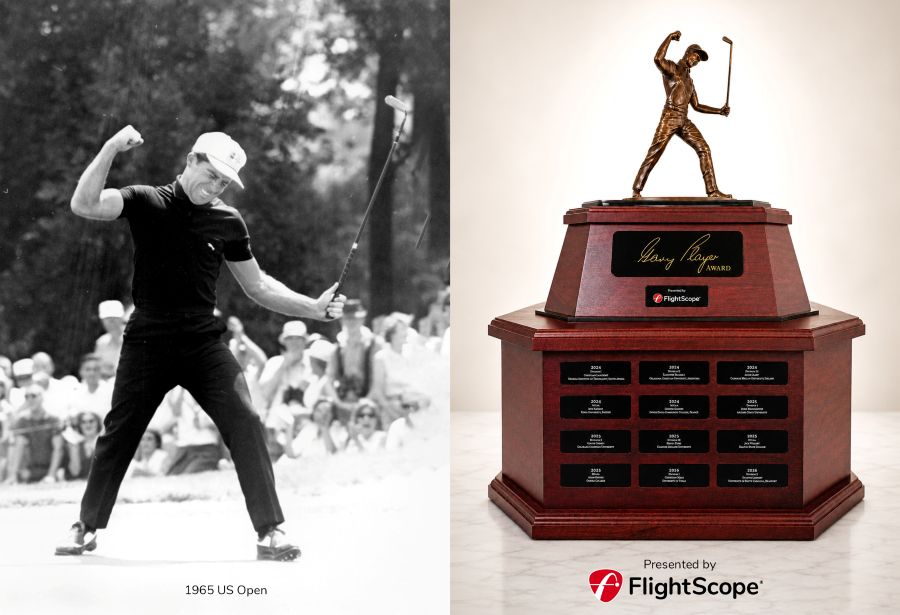
FlightScope has one. The company presents the Gary Player International Golfer of the Year Award in partnership with the Golf Coaches Association of America, honoring five non-American collegiate players, one each from NCAA Divisions I, II and III, plus NAIA and NJCAA. The 2026 class: Christiaan Maas of Texas by way of South Africa, Octavio Laurent of USC Beaufort by way of France, Alvin Su of Rochester by way of China, Iver Sokhan-Sanj of Keiser by way of Norway, and Abe Bignell of McLennan Community College by way of England. The trophy's statuette recreates Player's celebration after beating Kel Nagle in a playoff at Bellerive in 1965, the win that made him the third player ever and the first non-American to complete the career grand slam.
The tie-in is tidier than most sponsorship logic. FlightScope's origins are South African, and the technology started in 1989 tracking projectiles for the defense industry before anyone thought to point Doppler radar at a golf ball. An award for international collegiate players, presented by a company built on international radar work, named for the sport's original global commuter, at least holds together. Compare that to the average equipment sponsorship, where the connective tissue is that both parties said yes.
Why Does FlightScope Target GCAA College Golf?
The strategic read is simpler than the heritage story. College golf is the single highest-leverage installed base in the launch monitor category. A program buys one unit, keeps it for years, and every player on the roster learns to read numbers in that brand's format. Those players turn pro carrying a preference. Trackman understood this early and made its numbers the recruiting currency; a junior's carry and ball speed get quoted in Trackman terms because that is what the coach has. Foresight built its own beachhead through fitting studios. FlightScope's counter is not to outspend either one on hardware placement. It is to become the name attached to the honor the coaches themselves vote on, and to keep it there long enough that it stops looking like a sponsorship and starts looking like the award's actual name.
This will not move a brand tracker. FlightScope sits 69th of 215 in the DORMIED Index with zero movement month over month, and an awards presentation aimed at a few hundred collegiate coaches is not designed to change that. It is B2B spend wearing a public relations jacket. Judged as consumer marketing it is invisible. Judged as channel access it is one of the cheapest routes into a room where six-figure equipment decisions get made by people who talk to each other constantly and trust almost nobody outside that circle.
How Does FlightScope Compete With Trackman and Foresight?
The pressure on FlightScope is coming from both ends. Garmin, Rapsodo and Bushnell have collapsed the entry price for consumer radar to the point where the sub-$1,000 tier is a commodity fight FlightScope's Mevo line cannot win on margin. At the top, Trackman and Foresight own tour and fitting. The defensible ground is the middle: programs, academies and coaches who need tour-adjacent accuracy without tour-adjacent budgets, which is exactly where the X3 and the GCAA relationship point. Whether that holds depends on something the press release cannot tell you: how many of those 2026 winners' programs actually have a FlightScope unit in the bay. If the answer is most of them, the award is working. If it is a handful, FlightScope has bought a very well-designed trophy and not much else.