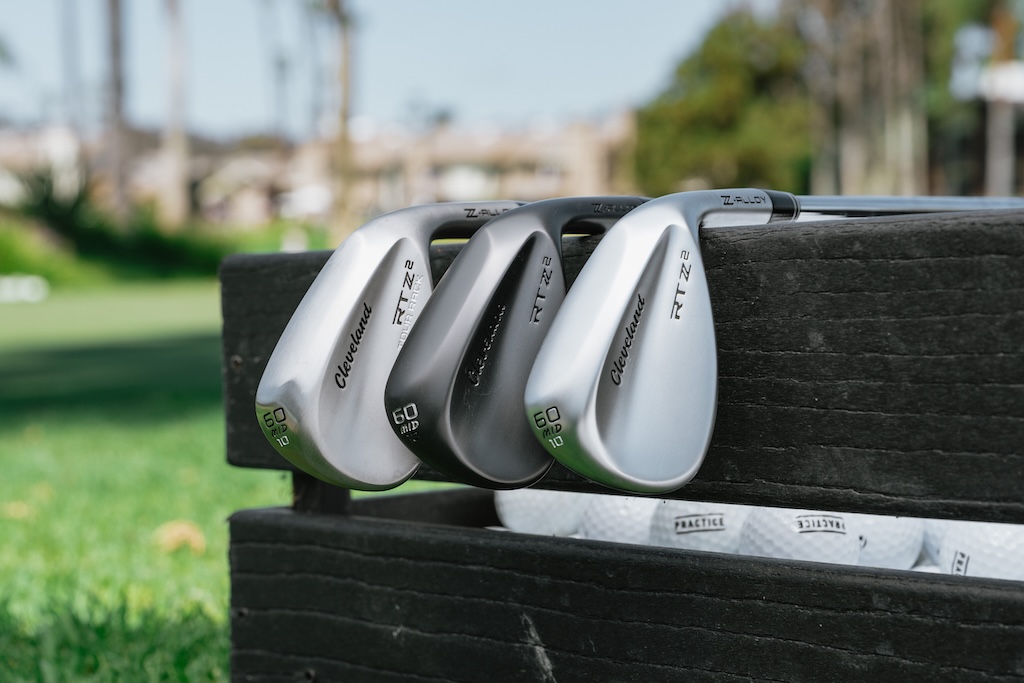
Bob Vokey has had his name stamped on the back of Titleist wedges since 1996. Roger Cleveland spent most of those same years across town at Callaway, designing Mack Daddy and Jaws, while the company bearing his surname sold enormous volumes of wedges without him. That arrangement ends, at least on paper, with RTZ 2.
What Is in the Cleveland Golf RTZ 2 Wedges Lineup?
Cleveland Golf announced its second-generation RTZ line this week, with pre-sale August 4 and retail availability September 4. Five sole grinds, lofts from 46 to 64 degrees, Tour Satin, Black Satin and Tour Rack finishes, Dynamic Gold as the stock shaft, and $199.99 at the blade level, $219.99 for Tour Rack. The headline addition is the return of the 588 grind, the sole shape that made the 588 Tour Action the most copied wedge of its era. The second headline is the man who signed off on it. Roger Cleveland is back in the building as Founder and Advisor, revisiting every grind and every transition in the lineup.
The press release says "nearly 50 years after introducing the groundbreaking 588 Tour Action Wedge." The 588 arrived in 1988. That is 38 years, which is still a long time to be relevant in a category where most product cycles are forgotten in 24 months. The math is generous, but the point survives it: no wedge sole has been imitated more often by more brands, and reintroducing it is the cheapest credibility Cleveland can buy right now.
Why Does Cleveland Golf Wedge Pricing Now Match Vokey?
The price is the actual news. Cleveland built its wedge business on undercutting Titleist. The RTX era lived comfortably below the Vokey line, and for two decades the pitch to the green-grass shop and the big-box wall was simple: same spin story, less money. At $199.99, that gap is functionally gone. Cleveland is no longer the value alternative in the blade wedge aisle. It is asking to be considered on equal terms, in a category where Vokey has held roughly half of the tour count for a generation and where amateur purchase behavior follows tour count more closely than it does in any other club category except the golf ball.
ZipCore iQ is the engineering justification for the number. The original ZipCore, introduced in 2020, swapped steel out of the hosel for a low-density core, moving the CG and raising MOI without touching the profile. iQ takes that idea and tunes the core per loft and grind combination, on the reasoning that a 60-degree LOW grind gets used differently than a 50-degree MID. That is a real claim, not a marketing one, and it is also a manufacturing headache. Five grinds across ten lofts across three finishes, each with its own hosel core geometry, is SKU proliferation at a scale that wedge buyers at retail will feel before golfers do. Somebody has to stock that wall.
Why Is the Cleveland Golf Upmarket Push a Risk?
Which is the tension in this launch. Cleveland is pushing upmarket and expanding complexity at a moment when its brand attention has cooled, down roughly 18 percent month over month in the DORMIED Index and sitting 30th globally. The heritage play and the founder's return are the right levers for a brand that needs to remind people it invented the modern wedge, but heritage does not move a $199.99 blade off a rack next to an SM11. Grinds do, and fitting does, and the Tour Rack customization program, with complimentary personalization through launch, is Cleveland finally treating wedge fitting the way Vokey WedgeWorks has for years.
The more interesting question is what happens underneath. Cleveland's structural advantage was never the blade. It was CBX, the cavity-back wedge for the 15-handicap that Titleist has never seriously contested and that TaylorMade and Callaway address only intermittently. If RTZ 2 pulls resources and shelf space upmarket while CBX drifts, Cleveland will have traded a category it owns for one it has spent 30 years finishing second in. Watch the tour bags in October. If the 588 grind shows up in professional hands rather than in nostalgia coverage, the $199.99 holds. If it does not, this becomes a very well-designed wedge sold at a price its brand has not earned back yet.