Ultralight wood shafts under 40 grams have been the fastest-growing segment in aftermarket fitting for three years running, and almost none of them measure under 5.5 degrees of torque. Aretera's new AO2 Blue 35 lands at 5.2, 5.1, and 4.9 across its three flexes. That number, if it holds up in independent testing, is the entire story.
How Does Aretera's Coreless Design Lower Torque?
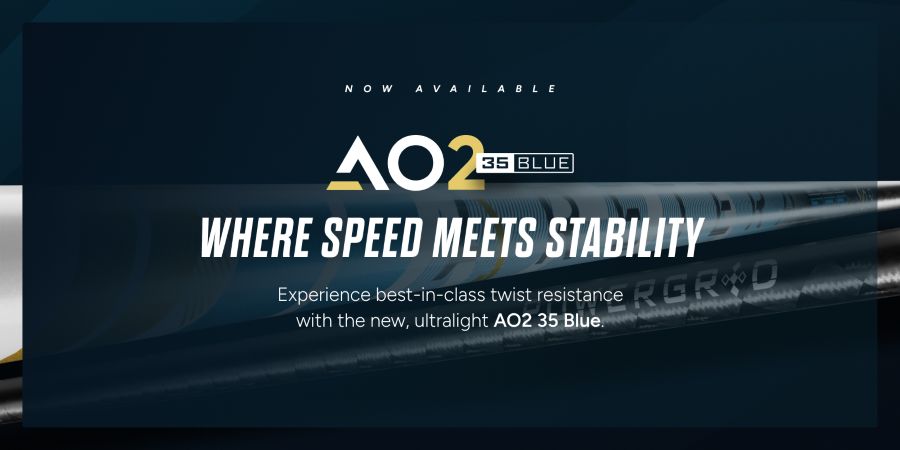
The Carlsbad shaft brand expanded its AO2 line this week with the Blue 35, a sub-40-gram wood shaft built on the same Coreless Design and PowerGrid spread-tow weave architecture Aretera introduced in its heavier profiles. Cofounder Alex Dee framed the launch around the engineering tradeoff every ultralight shaft maker runs into: thinner walls mean less material to fight twist, which is why most featherweight options carry torque numbers north of six degrees and a reputation for feeling like a fishing rod at the top.
For context, Mitsubishi's Diamana D-Limited 40 lists at 5.8 torque. Fujikura's Air Speeder 40 sits around 6.0. Graphite Design's Tour AD UB-4 is 5.7. If Aretera's 4.9 torque on the AO2 Blue 35 Flex 4 holds in third-party measurement, that's a meaningful gap in a category where 0.3 degrees is the difference between a fitter recommending the shaft and dismissing it. The Coreless construction, which replaces the traditional bias core with bias plies woven through the full wall thickness, is the engineering story Aretera has been telling since launch. The AO2 Blue 35 is the most aggressive test of whether that architecture actually delivers what the marketing says.
Can Aretera Break Into Premium Aftermarket Shaft Fitting?
The business question is harder. Aretera sits at #162 in the global brand index with a month-over-month decline of nearly 19 percent. The brand is competing in a premium aftermarket segment dominated by Fujikura, Mitsubishi, Graphite Design, and Project X, where the average buyer already has a shaft preference and a fitter who reinforces it. Breaking into that consideration set requires either a tour validation moment, which Aretera has not had, or a testing result from MyGolfSpy or TXG that forces the conversation. The AO2 Blue 35 is engineered for the second path. The torque numbers are the headline a tester would lead with.
The target customer here is specific: a 70-to-95 mph driver swing looking to preserve speed without the launch and dispersion penalty that comes with most ultralight options. That's a senior demographic with disposable income and a fitter relationship, which is the right buyer for a $500-plus aftermarket shaft. It's also a shrinking demographic relative to the brand's long-term ceiling. Aretera is solving a real problem for a real customer, but it's not the customer who builds a brand to scale.
What Does Aretera Need Beyond the AO2 Blue 35?
The AO2 Blue 35 is the kind of product that earns a brand respect in fitting bays before it earns volume on retail shelves. Whether Aretera can convert that respect into the tour seedings and independent testing wins that move a shaft brand from #162 to inside the top 50 is the next 18 months. The engineering claim is credible. The distribution and validation playbook is the harder problem.