Shot-tracking companies sell hardware, but the asset that actually appreciates is the database. Arccos just spent that asset in public, publishing a 1.34 million-hole par-5 study through MyGolfSpy as the first installment of a series called Smarter Golf, and the finding it landed on takes a swing at two decades of range-lesson orthodoxy.
What Did the Arccos Golf Par-5 Study Find?
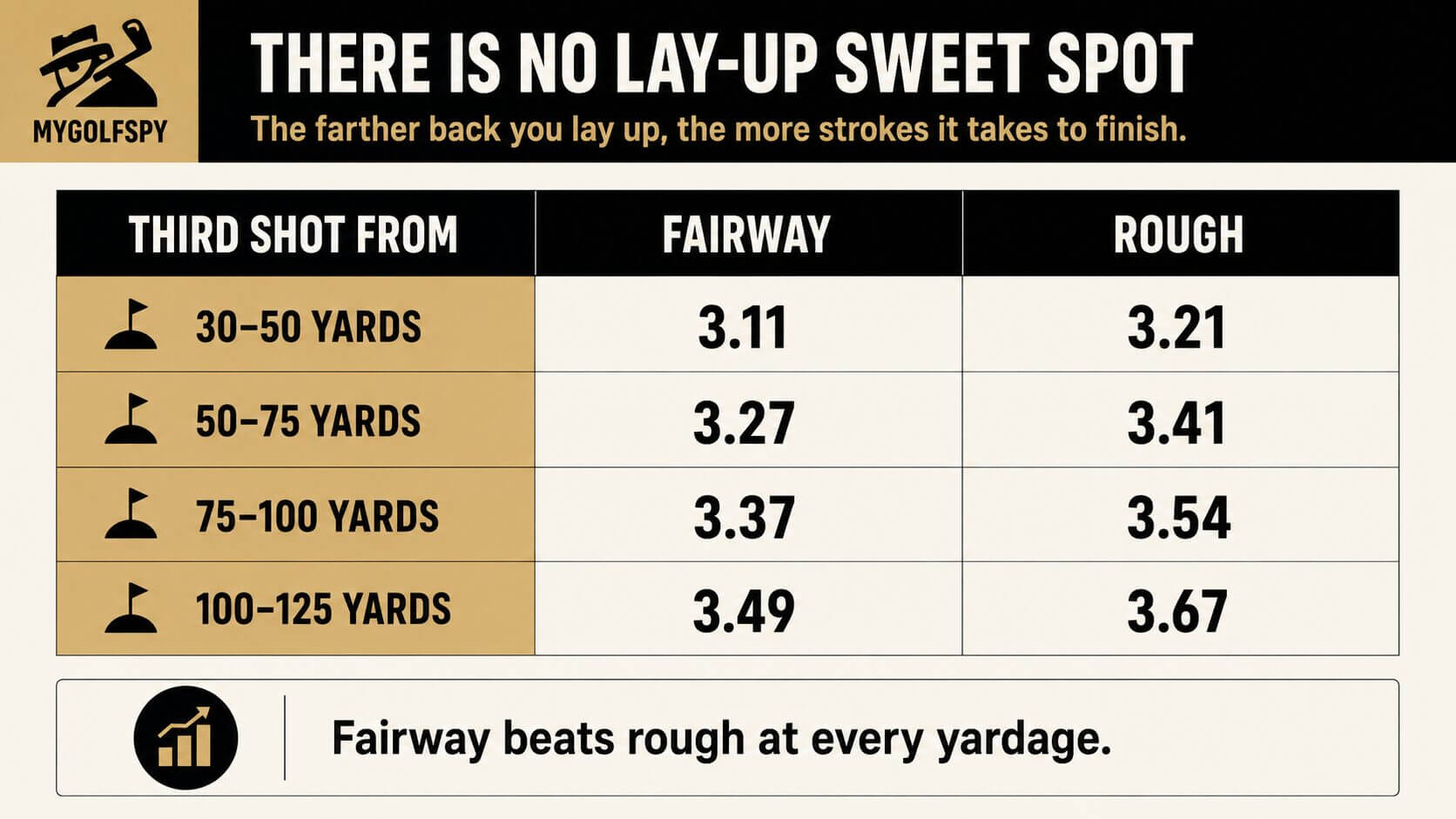
The study pulled par-5 performance from 18,285 USGA-handicapped golfers over a full year and tested one decision: lay up to a comfortable number, or advance the ball as far as trouble allows. There is no sweet spot. Strokes to hole out get worse in a straight line the farther back a player lays up, at every distance in the set. Backing off from 60 yards to 100 yards costs roughly 0.22 strokes, and the curve never turns around. The only variable that moves the number meaningfully is lie: fairway beats rough by 0.09 to 0.18 strokes at every yardage. The clean instruction is to lay up to a spot, not a number.
The second finding is the one with teeth. Isolating second shots from the fairway between 180 and 260 yards, Arccos compared golfers who finished on or within 40 yards of the green against those who laid back. Going for it won at every handicap band. At 20 handicap, the birdie-or-better rate more than doubled and the bogey-or-worse rate fell by close to a third. Aggression did not trade blow-ups for birdies. It improved both ends of the scorecard simultaneously, which is not how most amateurs, or most instructors, model risk.
Why Does the Par-5 Lay-Up Strategy Still Get Taught?
This is the same intellectual lineage as Mark Broadie's strokes-gained work, which demonstrated that laying back off the tee to a preferred yardage costs more than the crooked drive it avoids. The lay-up number survived that reckoning because it lived in short-game coaching, where the Pelz-era teaching that a full swing is more repeatable than a partial one hardened into a rule nobody re-tested. It is worth noting how much of amateur course management is inherited rather than measured. Arccos has also been the source of the more uncomfortable data point in the category, that amateur driving distance has moved almost nowhere across nearly a decade of tracked rounds. Equipment has not fixed scoring. Decision-making is the cheaper lever, and par-5s are where the spread is widest: a scratch player is +0.12 on them and birdies one in five, while a 20-plus handicapper is +1.51 and makes double or worse close to half the time.
The business read matters as much as the golf. Sensors are commodity hardware now. Cobra has been embedding Arccos into grips since 2016, Garmin autodetects shots on a wrist, Shot Scope undercuts on price, and Game Golf's arc showed how quickly a hardware-first tracker can lose the room. What Arccos owns that competitors cannot replicate quickly is a decade of tagged amateur shots at scale, and publishing findings from it is the closest thing to a defensible marketing position the category offers. Placing the series on MyGolfSpy rather than the company blog is the tell. Arccos has the data and MyGolfSpy has the audience that argues about it, and the funnel terminates at Arccos Air, the passive-capture product for golfers who will not log shots manually.
Can Arccos Golf Turn Its Data Into an Advantage?
The brand sits 28th of 215 in the DORMIED Index with a flat month, which is roughly the profile of a company with excellent inputs and quiet distribution. That is precisely the gap a data-led content series is built to close. Watch whether the next installments pick fights as specific as this one, because the value here is not the topic, it is the willingness to publish a number that contradicts what golfers were taught. Do that four or five more times and Arccos stops being a subscription attached to a grip sensor and becomes the reference source for how amateurs should actually play holes.