The barrier to entry in wedges has never been casting. It is SKU count. Three bounce options across lofts from 50 to 60 degrees produces north of 20 stock configurations before anyone builds a left-handed run, and every one of those heads sits in a warehouse until a fitter puts it in a customer's hands. That inventory math is why value brands historically stop at one grind and call it a wedge line.
What Are the Exotics Milled Bounce Options and Price?
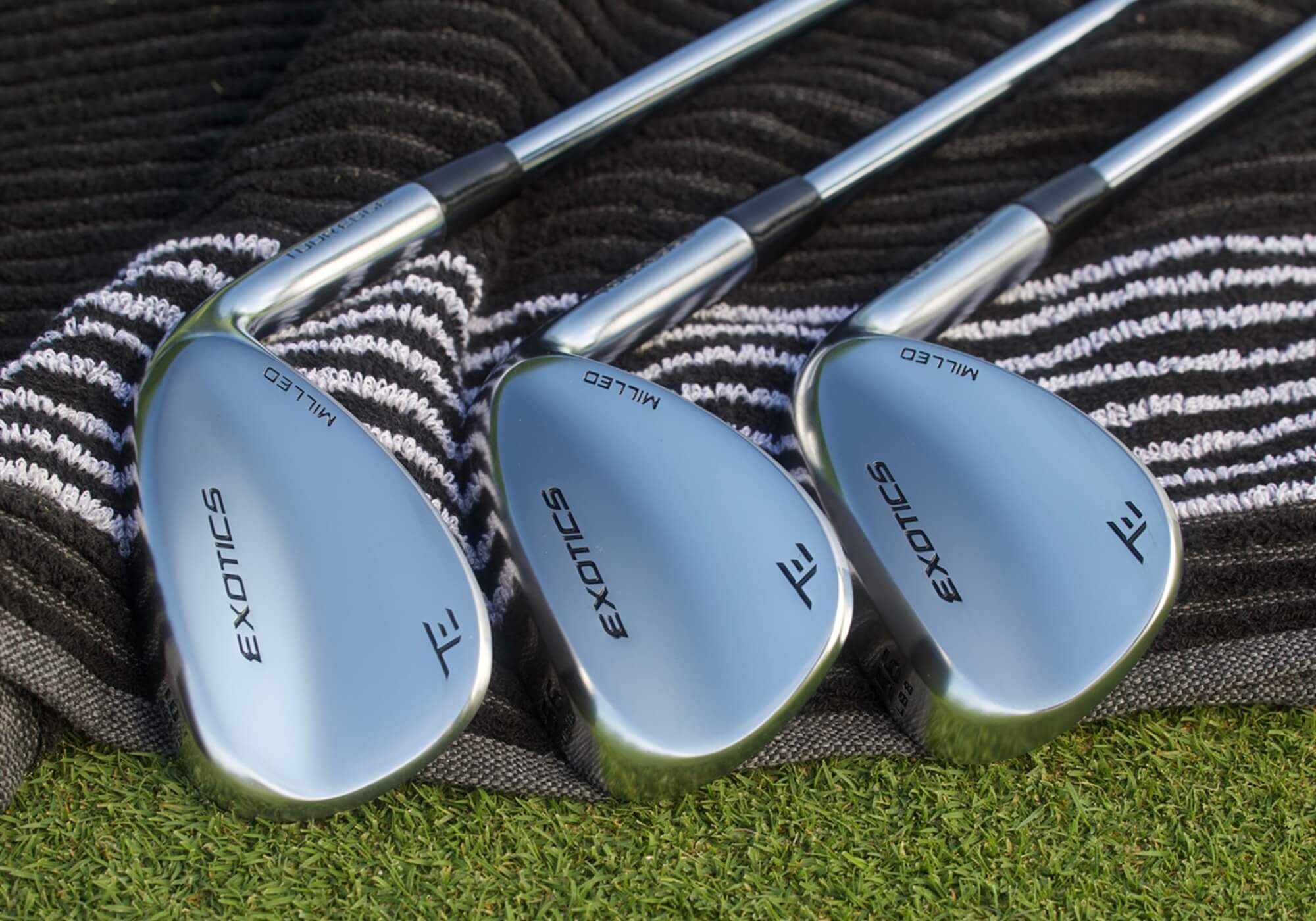
Tour Edge is no longer stopping. The Exotics Milled wedge line hits retail Sept. 14 at $110 per club, with three bounce profiles: LB in 54, 58 and 60 degrees, MB across the full 50 to 60 range, and HB from 54 through 60. The heads are cast 304 stainless with CNC-milled faces, grooves and sole details, packing more grooves onto the face at maximum conforming depth under the name SuperSpin. The sole is a three-part shape Tour Edge calls TriGrind: chamfered leading edge, flatter mid-sole, heavy trailing-edge relief.
The context here is 40 years of a company known for one thing. David Glod built Tour Edge on fairway woods and hybrids, and the Exotics line spent two decades as the answer to a specific question about the 3-wood slot. The wedge box stayed unchecked. The Wingman forged wedge co-designed with Bernhard Langer offers three grinds but starts at 52 degrees in a high-toe shape and sits well above this price point. What was missing was a mainstream, fitting-friendly wedge with a bounce conversation attached. That is the actual product being launched here, not a groove.
Why Did Tour Edge Publish Losing Spin Data?
The more interesting disclosure is in the testing document. Tour Edge published internal spin data showing both unnamed competitors out-spinning the 56-degree Exotics Milled from 40 yards, by 60 and 155 rpm, and one competitor beating it by nearly 300 rpm from 70 yards. OEMs do not publish losses. The last comparable instance was Cleveland reporting a Turbo Launcher fairway wood as the second-longest carry in its own test, then explaining the total-distance case. The wet-condition numbers, where the Exotics gave up under 950 rpm at 70 yards against 1,600 to 4,000 for the competition, are worth substantially more because of the dry numbers printed above them. Credibility is the only currency a smaller OEM can spend against Vokey.
Which brings up the pricing problem, and it is a problem. At $110 with a KBS Hi-Rev 2.0 115-gram shaft and Golf Pride Tour Velvet 360 stock, Tour Edge is roughly 40 percent under where premium wedges from the majors now sit, with no downgrade in the build. Consumers read cheap as worse, particularly in a category where the purchase is emotional and the incumbent has spent 25 years teaching golfers that grind selection is an act of self-knowledge. Marketing VP Jon Claffey has been explicit that the brief is to stop leading with price and let it land at checkout. That only works if the club gets into a fitting cart first, which is exactly where Tour Edge's green-grass and independent-shop distribution is stronger than its shelf presence at big-box.
Why Could Wedges Change Tour Edge's Visibility?
Tour Edge sits at #48 globally and moved zero percent month over month, which is the signature of a brand producing good product without generating conversation. Wedges are the category most likely to change that, because they are bought more often than drivers, discussed more obsessively, and evaluated on feel that a fitting bay can actually deliver. The thing to watch after Sept. 14 is not review scores. It is whether Tour Edge holds $110 through the first discount cycle. A value brand that starts promoting a $110 wedge in February has told the market exactly what it thinks the club is worth.