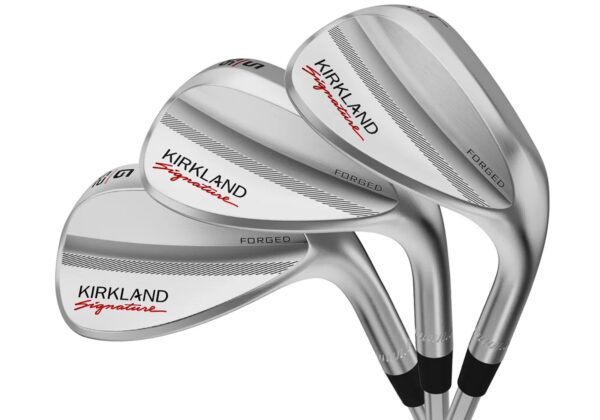
Three forged wedges for $199.99 is not a price point. It's a statement about how much margin the rest of the wedge category has been pocketing for years.
What Do the Kirkland Signature Gen 3 Wedges Offer?
The Kirkland Signature Gen 3 Forged wedge set hit Costco's website this week, almost exactly eight weeks after appearing on the USGA Conforming List in April. The set includes a 52, 56, and 60 in right-handed only, with a sandblasted raw face, a progressive CG design, a Kirkland-branded Wedge Flex shaft, and a Lamkin Crossline 360 grip. Carbon steel forged, though Kirkland is conspicuously vague about whether that's 1020, 1025, or something else entirely. The omission matters because the feel difference between 1020 and 8620 is the entire pitch of a $180 Vokey.
The context here is what the rest of the category is doing. A single Vokey SM10 retails for $189. A Mack Daddy CB goes for $170. Cleveland's RTX 6 sits around $170 a wedge. Kirkland is asking $66 per club for a forged head, a brand-name grip, and a shaft that, fine, nobody knows much about yet. Even if you assume the Costco set plays one tier below the premium options on feel and grind sophistication, the math gets ugly fast for anyone trying to sell a three-wedge setup at $500-plus.
Who Are These Costco Golf Wedges Actually For?
The limitations are real and worth naming. No grind options, no bounce variants, no left-handed, and standard lofts only. A scratch player who plays the same 58.10 every round is not the target. The target is the 12-handicap who currently games a hand-me-down sand wedge from 2014 and has been told for a decade that forged feel is a luxury. Kirkland just made it a Costco impulse buy next to the rotisserie chicken. The raw face will rust, the shaft is an unknown, the resale value will be nothing. None of that matters at this price.
What's actually happening here is the same playbook that broke the golf ball category in 2017. Kirkland didn't invent forged wedges any more than they invented the urethane ball. What they do is expose how much of a premium product's price is the product and how much is the brand, the tour seeding, the retailer margin stack, and the marketing budget. The four-piece Kirkland ball forced Titleist to defend the Pro V1 on performance rather than reputation. The Gen 3 wedge does the same thing to Vokey, Cleveland, and the smaller forged players like Edel and Indi who actually do offer the grinds and customization Costco never will. Those brands now have to justify a 2.5x markup to a customer who can drive to Costco on a Saturday.
How Does Kirkland Golf Pressure Fitters and Rivals?
The second-order effect is the one to watch. Independent fitters and club pros, the ones who already operate on margins thinner than a milled face, now have to explain to a member why the Vokey fitting is worth it. The answer exists. Grinds matter, bounce matters, fit matters. But the conversation just got harder, and the customer walks in already anchored to $200 for three wedges.
Kirkland's golf trajectory tells the story in the numbers. The brand jumped 81% month-over-month in April and still sits at #122, which means almost all of that movement is happening on a small base of golf-specific attention. That changes the day Costco shoppers who never followed equipment news pick up a set on a grocery run. The Gen 3 wedge is the product that turns Kirkland from a golf curiosity into a category force, and the brands sitting between $150 and $200 per wedge should be having uncomfortable meetings this week.