Content marketing usually exists to sell the thing the publisher makes. Foresight Sports just put out an interview about indoor practice in which its own simulation software, FSX Play, is never named once, SkyTrak gets the warmest paragraph in the piece, and the product Foresight is credited with building is GSPro, which Foresight did not build.
Who Actually Builds GSPro Golf Simulator Software?
The piece is a Q&A with Jon Sherman of Practical Golf, a genuinely useful conversation about bridging the gap between sim reps and course performance. Sherman's advice is sound: work the awkward wedge window from 30 to 80 yards, track stock carry numbers off typical strikes rather than career ones, run 20 to 30 ball dispersion tests with the driver and the long clubs, and use consequence-based practice, like a water carry that punishes a 7-iron that does not reach 145. He credits GSPro's playground mode, added roughly 18 months ago, for letting users reshape greens, add elevation and randomize yardages. He calls it Foresight's GSPro. It is not.
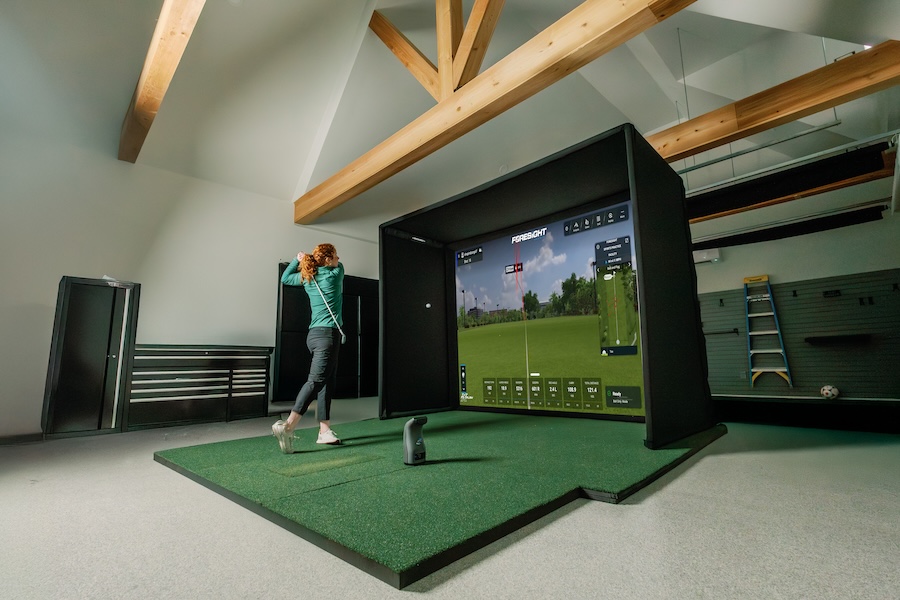
GSPro is an independent software product built by a small outside team, sold on its own subscription, populated by a community course library, and connected to Foresight units, along with Uneekor, Bushnell and others, through an open API. Foresight sells the photometric hardware. GSPro sells the reason the owner walks into the room at 9pm in February. That distinction is now invisible to the customer, which is exactly the problem, and this article is the proof: a knowledgeable enthusiast who has been practicing indoors for eight years attributes the software to the hardware brand, and the hardware brand publishes it without correction.
Why Does Foresight Sports Risk Losing the Software Layer?
There is precedent for this kind of layer separation, and it rarely ends well for the hardware. Arccos built the shot-tracking layer that Cobra Connect grips ride on, and the tracking brand, not the club brand, owns the relationship with the data. In the sim category the risk is sharper, because the hardware is the expensive purchase and the software is the recurring one. A GCQuad is a five-figure decision made once. GSPro is a few hundred dollars a year, renewed every year, and it is where the actual usage happens. Foresight spent years winning the photometric-versus-radar argument against Trackman on measurement accuracy, and accuracy remains its case. Vista Outdoor paid roughly $474 million for the company in 2021 on the strength of that case. Accuracy is not what keeps a home sim owner engaged in month fourteen.
The article also does something a marketing department would normally flag. Sherman frames SkyTrak as delivering strong value at an attractive price point compared to high-end systems like Trackman, praises SkyTrak's speed training platform as more robust than Flightscope's, and compliments Uneekor's AI swing analysis. Foresight published all of it. Read charitably, that is a brand confident enough to host an honest conversation about a category it helped create. Read structurally, it is a brand that has stopped fighting for the software layer and is content to be the measurement device inside someone else's practice session. A DORMIED global rank of 113 out of 215, flat month over month in a category with more consumer attention than it has ever had, suggests the market is reading it the second way.
How Can Foresight Sports Answer GSPro's Playground Mode?
The correction available here is not a press release. It is FSX Play doing what GSPro's playground mode does, at the level of customization Sherman is describing, and Foresight telling people it does. Hardware advantages in this category compress every product cycle. Software habits do not. Whichever company owns the thing the golfer opens at night in January owns the renewal, the data and eventually the next hardware purchase. Right now, at Foresight, that is a third party, and Foresight is publishing its praise.