An LPGA endorsement costs a fraction of the equivalent PGA Tour deal, and the gap is wider in launch monitors than in clubs or apparel, because a tech brand is buying visibility rather than a bag placement. FlightScope just bought five of them at once.
Who Are the New FlightScope LPGA Ambassadors?
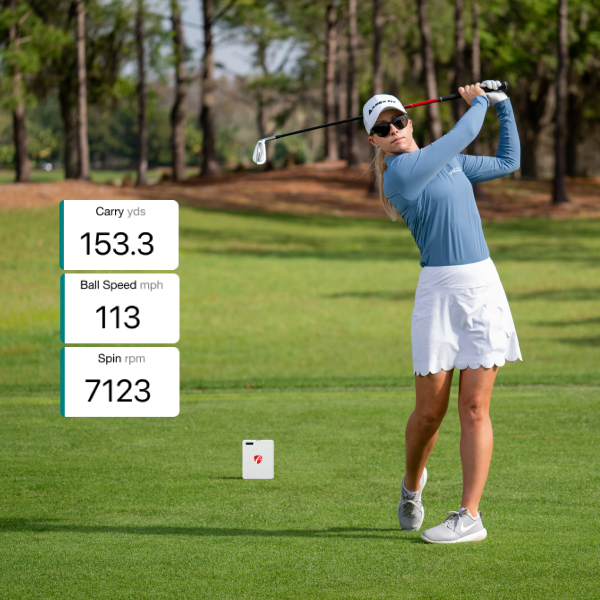
Maja Stark, Megan Khang, Allisen Corpuz and Brianna Chacon join the roster on the X3C, the carbon fiber radar unit that reads 50-plus parameters and carries FlightScope's Environmental Optimizer, which lets a player model altitude, wind and temperature for a course she has not seen yet. Jodi Ewart Shadoff goes on the Mevo Gen2, the consumer-side unit running Fusion Tracking, radar plus synchronized image processing, for 18 ball and club parameters. Quietly attached to the announcement is Grant Waite, a Golf Digest Top 50 coach who works with multiple LPGA players and uses the X3C in his teaching. Waite is the most consequential name on the list, and he is not the headline.
That inversion is the story. Launch monitor companies do not win the category through players. They win it through the coaches, academies and fitting bays that buy multiple units and put them in front of hundreds of paying customers a year. Trackman built its tour dominance that way, one range and one instructor at a time, and it did so despite arriving in 2003, fourteen years after FlightScope's radar work began in the defense sector tracking projectiles. Being first to the physics has never been the same thing as owning the room.
Why Does FlightScope Trail in the Golf Launch Monitor Market?
FlightScope's real problem is not accuracy, and anyone who has read the independent comparison testing knows that. It is share of voice. The brand effectively created the sub-$1,000 consumer radar segment with the original Mevo in 2017, and then watched Rapsodo and Garmin take the volume with better retail placement and louder consumer marketing. A #73 global position and a flat month-over-month reading is what a technically respected brand looks like when it is losing the awareness battle rather than the engineering one. Five ambassadors will not fix that alone, but ambassador content is among the cheapest per-impression assets available in golf right now, and LPGA deals price lower than anything comparable on the men's side.
There is also a segmentation point buried in the release worth noting. Four players on the X3C, one on the Mevo Gen2. That is a brand telling its two audiences apart: the tour-grade radar for the professional and the coach, the portable unit for the golfer with a net in the garage. Most competitors in this category have collapsed their messaging into a single hero product and hoped the halo carries downward. Splitting the roster by product tier is more honest and, commercially, more useful, because the Mevo buyer wants to see a player who travels with the same box she can afford.
How Could FlightScope Turn the Roster Into Distribution?
The question for the next twelve months is whether any of this converts into placement. Signing LPGA players is inexpensive. Getting X3C units onto tournament ranges where they show up in broadcast cutaways, and into the teaching operations that generate repeat unit sales, is the harder and more valuable outcome. Waite is the test case for that second path. If FlightScope treats this as a photo roster, it will read the same in June 2027 as it does now. If it treats Waite as the wedge into the LPGA coaching network the way Trackman treated academy instructors two decades ago, the roster becomes a distribution channel rather than a press release. Watch which one the brand is actually building.