Two brands, seven rangefinders, and the same entry price to the penny. Bushnell's A-1 Slope and Garmin's Approach Z10 both land at $299.99, which tells you less about manufacturing cost than it does about how carefully both companies are holding a floor that no longer reflects what the category costs to build.
How Does the Bushnell vs Garmin Rangefinder Lineup Compare?
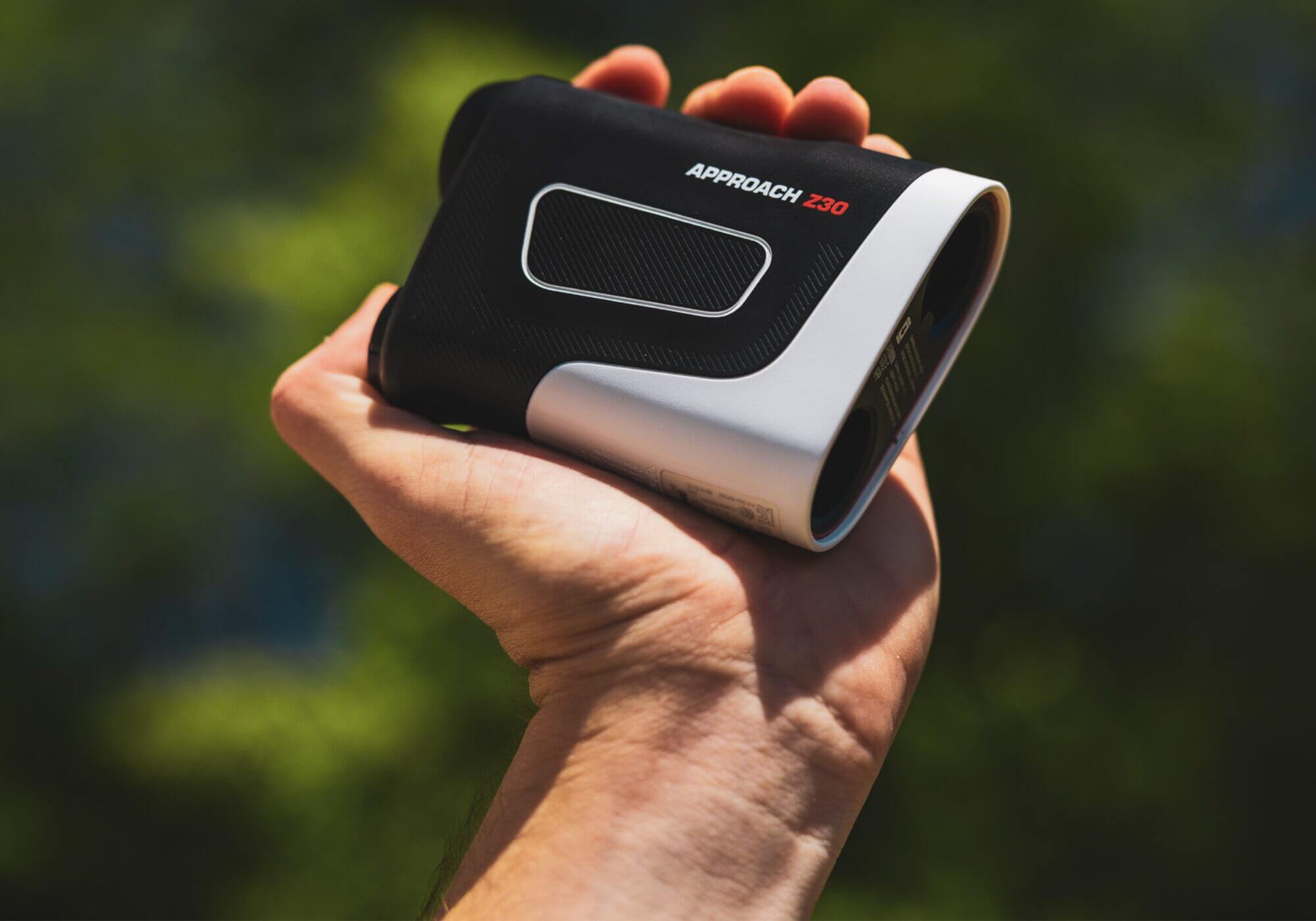
MyGolfSpy's 2026 testing pool sets up the comparison plainly. Garmin fields three rangefinders: the $599.99 Approach Z82, which scored 9.3/10 back in 2023 and still carries the most ambitious display in the segment; the $499.99 Approach Z30, which took Editor's Choice in 2026 and lost points only on price; and the new $299.99 Approach Z10, which does most of what the Z30 does with a lesser display and 50 fewer yards of range. Bushnell runs four rungs at even $100 intervals: the Pro X3+LINK at $599.99, the Tour Hybrid at $499.99, the Tour V7 Shift at $399.99 and the A-1 Slope at $299.99.
The interesting number in that list is not either flagship. It is 9.6, the score the $399.99 Tour V7 Shift posted as 2026 runner-up. Fast acquisition, premium glass, LINK connectivity, and a price $200 under the Pro X3+LINK. Bushnell has built the strongest argument in its own lineup against its own flagship, which is a familiar problem for any brand that ladders four SKUs into a mature category. Garmin has the same problem in reverse: the Z10 arrived and made the Editor's Choice-winning Z30 difficult to defend at a $200 premium a few months after it won.
Why Does Bushnell Protect the Sub-$300 Rangefinder Tier?
What both brands are actually protecting is the bottom of the range. Bushnell's A-1 Slope gives you slope, a compact body and Pin Jolt for $299.99, and that is close to the full feature list. It is not a bad device. It is a placeholder, priced to keep a Bushnell logo in the sub-$300 bay so shoppers do not wander down to the sub-$200 challengers who have spent the last five years proving that laser distance measurement is not hard technology anymore. Optics and target acquisition still separate the tiers. Getting a number on a flagstick does not.
Bushnell's history in this category is why the pressure registers. It set the standard when distance-measuring devices were tour practice-round curiosities, and it was the incumbent in players' bags when the PGA of America permitted devices in competition at the 2021 PGA Championship. That kind of default-brand status is durable, but it does not price a product. The move into golf speakers with Wingman was the tell: when a company that owns a category starts selling audio, it has read the margin trajectory on its core product and gone looking for a second one.
Which Golf Rangefinder Is Worth Buying in 2026?
The honest read for a buyer is that neither $299.99 unit is where the value sits, and both brands know it. A first-time buyer keeping costs down should be shopping outside these two lineups entirely. A golfer who plays enough to care about glass quality and lock-on speed should be looking at the $399.99 tier, where Bushnell currently has the strongest product-to-price ratio in either catalog. The $599.99 flagships are for players who genuinely use green contour and wind inputs, which is a smaller population than the marketing implies.
Bushnell sits at 59th globally in the DORMIED Index this month, flat month over month, which is a strange place for a brand with this much category recognition. That gap between name awareness and measurable brand momentum is the thing to watch. Bushnell's next real test is not another premium laser. It is whether it defends the $300 tier with a product worth the price or lets the sub-$200 field take the entry buyer and keeps harvesting the top of the market for as long as that lasts.