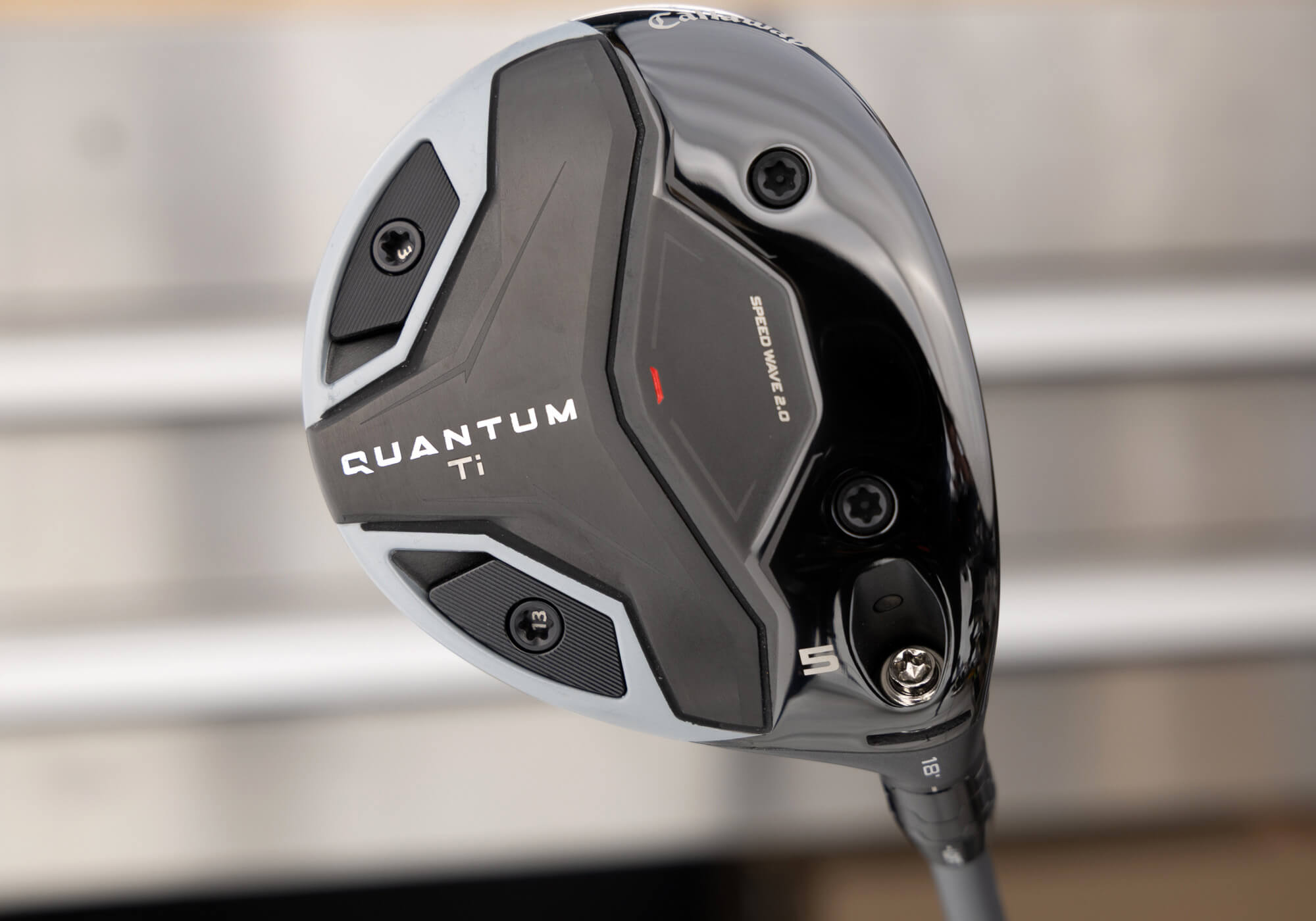
Full titanium construction in a fairway wood was always going to cost you. Callaway's new Quantum Ti prices itself at $549.99, putting it squarely in driver territory and signaling where premium materials are headed as they migrate down the bag.
What Makes the Callaway Quantum Ti a Bomber Fairway Wood?
The pitch is straightforward: a fairway wood that hits like a mini driver off the tee but remains playable off the turf. Callaway calls it a "bomber fairway," which is marketing speak for a club that splits the difference between its 340cc Quantum mini and a traditional 3-wood. The titanium build frees up weight for optimized CG positioning, and OptiFit 4 hosel adjustability adds independent lie angle tuning. Available in 15 and 18 degree options, though the absence of a 13.5 degree head undercuts the bomber positioning. An 18 degree 5-wood is many things, but "tee ball weapon" is not one of them.
Callaway sits at fourth globally in brand momentum, up 23 percent month over month. That trajectory suggests the company can push pricing boundaries without losing its core audience. Whether recreational golfers follow along at $550 per fairway wood is a different question entirely.
Why Does Callaway's Titanium Fairway Wood Worry Titleist?
The Titleist Problem Gets Worse
Callaway's $550 fairway wood creates a specific headache for Titleist, and it has nothing to do with price elasticity. It has everything to do with brand positioning in the premium segment.
Titleist has owned the "serious golfer" market for decades through a simple formula: professional validation plus understated aesthetics plus premium pricing. The GT line of fairway woods sits at $399, which until now represented the ceiling for fairway wood pricing outside custom builds. Callaway just moved that ceiling and did so with a product story that directly challenges Titleist's core value proposition. Titanium construction, adjustable lie angles, optimized CG. These are the talking points Titleist typically deploys to justify its price premium over mass market competitors.
The competitive dynamics here are uncomfortable for Acushnet. Titleist cannot ignore a $550 fairway wood from a top four momentum brand. Matching the price point without a comparable material story looks like opportunism. Building a titanium fairway wood takes time Titleist may not have if Callaway's Quantum Ti gains traction among low handicappers. The alternative, staying at $399 and ceding the ultra premium position, risks letting Callaway redefine what "serious equipment" means in the fairway wood category.
DORMIED data shows Titleist's brand momentum sitting flat over the past quarter while Callaway climbed 23 percent. That gap matters less in drivers, where both brands compete effectively, and matters enormously in fairway woods, where Titleist's TSR line has maintained strong market share through perceived performance advantages. A titanium competitor at $150 more signals that Callaway believes it can peel away Titleist's most valuable customers: the ones who buy based on technology rather than tradition.
The broader issue is demographic. Titleist skews older and more loyal. Callaway skews younger and more willing to experiment. Introducing a $550 fairway wood is not about converting Titleist loyalists today. It is about establishing Callaway as the default premium choice for the next generation of serious players who have no existing brand allegiance.
Titleist will likely respond within eighteen months, either with a material upgrade to the GT line or a new ultra premium tier. The question is whether waiting that long costs them positioning they cannot recover.
How Will Fitters Sell a $550 Callaway Fairway Wood?
The Fitting Bay Becomes a Showroom
Callaway's $550 price point changes the economics of club fitting in ways that extend beyond margin calculations. At this price, the Quantum Ti transforms every fitting session into a high stakes demonstration of perceived value. Fitters now carry the burden of justifying a $150 premium over Titleist's GT fairway woods with launch monitor data that may or may not show meaningful differences for the average low handicapper.
The fitting channel has historically served as neutral ground where performance trumps marketing. A fitter recommends what the numbers support, and price enters the conversation only after the data speaks. Callaway's titanium fairway wood disrupts this dynamic by introducing a variable that numbers alone cannot resolve. Two clubs producing identical ball speeds and spin rates now carry dramatically different price tags, forcing fitters to articulate value propositions that venture into subjective territory.
DORMIED tracking of fitting facility sentiment shows Callaway's brand perception among certified fitters running 12 percent higher than twelve months ago. That goodwill creates runway for the Quantum Ti in ways that direct to consumer channels cannot replicate. A fitter who believes in Callaway's engineering story becomes a $550 fairway wood's most effective salesperson. A skeptical fitter becomes an insurmountable obstacle.
The risk for Callaway lies in oversaturation at the premium tier. Paradyne AI drivers, Elyte irons, and now Quantum Ti fairway woods create a full bag proposition that exceeds $3,000 before adding a putter or wedges. Fitting facilities report that customers increasingly treat sessions as research trips rather than purchase occasions, gathering data to inform online buying decisions. A $550 fairway wood amplifies this behavior by raising the stakes of an impulse purchase.
Callaway's fitting bay strategy will likely emphasize the technology demonstration over immediate conversion. The company needs players to experience the titanium difference in controlled settings where launch monitors validate the premium. Whether that experience translates to credit card swipes depends entirely on how effectively Callaway trains its retail partners to close at price points the industry has never tested in this category.