
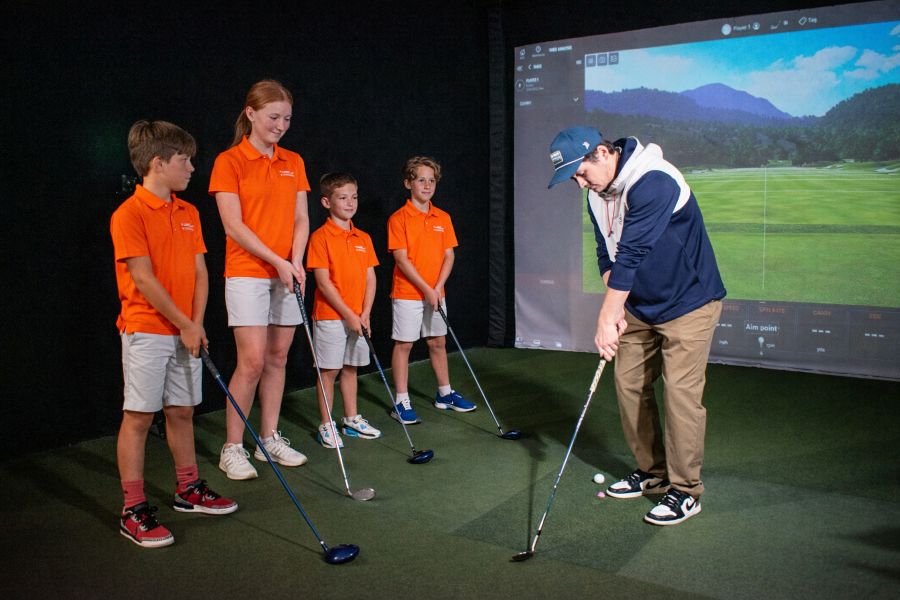
Five Iron Golf is betting that the future of player development runs through climate-controlled bays before it ever reaches the first tee. The indoor golf chain announced a spring offensive of programming designed to formalize what has largely been an informal relationship between simulator practice and actual golf.
The centerpiece is a Spring Tune-Up program that pairs PGA and LPGA instructors with Trackman data to establish performance baselines before outdoor season kicks off. It is a clever play that acknowledges what most golfers already know: launch monitor sessions are only useful if they translate to the course. The company is also piloting PGA Jr. League at its Rockefeller Center location, a move that could scale across its 40-plus venues if the team format gains traction with the 7-to-13 set.
More interesting is the Green Grass Pass, which gives members preferred access to private clubs and championship courses. This is Five Iron trying to close the loop on a membership that otherwise lives entirely indoors. Trackman sits at 20th in global brand intelligence rankings, a reminder that launch monitor technology has become table stakes for serious instruction. The question for Five Iron is whether it can own the full journey from data to divot.
The Indoor Arms Race Heats Up
Five Iron's programming push arrives at a moment when the indoor golf sector faces its first real shakeout. The post-pandemic boom created a crowded field of simulator venues, many of which treated the technology as the product rather than a means to an end. That approach is hitting its ceiling. Golfers who paid premium rates for bay time during lockdowns now have options, and the novelty of hitting into a screen has worn thin for anyone who can access an actual driving range.
Trackman's position in this ecosystem deserves closer examination. The company has maintained its reputation as the gold standard for professional instruction, but competitors like Foresight Sports and Full Swing have carved out significant market share in the commercial venue space. Full Swing's acquisition by Topgolf gave it access to a massive footprint and a direct line to casual golfers. Foresight has pushed hard into the home simulator market, betting that serious players will invest in permanent setups rather than pay monthly memberships.
Trackman's 20th place ranking in global brand intelligence reflects this fragmented landscape. The brand retains credibility with teaching professionals and tour players, but it lacks the consumer-facing presence of competitors who have invested heavily in entertainment experiences. Five Iron's decision to build programming around Trackman data rather than simply featuring the hardware suggests a pivot in how launch monitor brands might differentiate going forward. The value proposition shifts from accuracy specs to actionable outcomes.
The junior golf pilot at Rockefeller Center points to a demographic calculation that most indoor venues have ignored. PGA Jr. League has established infrastructure and parent buy-in that Five Iron can leverage without building from scratch. If the format works in a Manhattan flagship, replication across 40 venues creates a pipeline of future members who view simulator practice as foundational rather than supplemental.
This programming approach also creates switching costs that hardware alone cannot generate. A golfer with a performance baseline established through Trackman at Five Iron has a reason to return that transcends bay availability or pricing. The data becomes a retention tool.
The next twelve months will reveal whether Five Iron can execute this strategy at scale or whether it remains a pilot program generating press releases. Success means the company becomes a development platform. Failure means it stays a landlord renting screen time.
The Data Portability Problem
Five Iron's strategy assumes golfers will value continuity in their performance data, but this assumption collides with a fundamental limitation in the launch monitor industry. Trackman, like most competitors, operates within a closed ecosystem where data lives on proprietary platforms with limited export functionality. A golfer who builds a performance baseline at Five Iron cannot easily transfer that history to a home simulator running Foresight software or a lesson with a teaching professional using Garmin's R10. The switching costs Five Iron hopes to create depend entirely on Trackman's willingness to keep those walls intact.
This creates an uncomfortable dependency for Five Iron's business model. Trackman controls the data infrastructure that makes the programming strategy viable. If Trackman ever moves toward open data standards or if a competitor builds a translation layer that makes cross-platform comparison possible, Five Iron loses a key retention mechanism. The company is essentially betting that fragmentation in the launch monitor market will persist indefinitely.
The broader industry has shown little appetite for interoperability. Each major launch monitor brand maintains its own metrics, terminology, and data storage systems. A "smash factor" on Trackman does not map directly to the same metric on Foresight, and spin axis measurements vary between platforms in ways that confuse golfers trying to compare sessions. This chaos benefits venue operators in the short term by creating artificial lock-in, but it frustrates the serious players who represent Five Iron's core demographic.
DORMIED data shows Trackman's brand perception scores highest among teaching professionals and lowest among recreational golfers who have used multiple platforms. This gap suggests that Trackman's reputation for accuracy does not translate into loyalty among consumers who lack the technical knowledge to distinguish between competing systems. Five Iron's programming push may help bridge this gap by giving recreational golfers a reason to care about Trackman specifically rather than launch monitors generically.
The company's next move should involve pushing Trackman toward better data visualization tools that make performance trends accessible to average golfers, not just instructors interpreting numbers on their behalf.