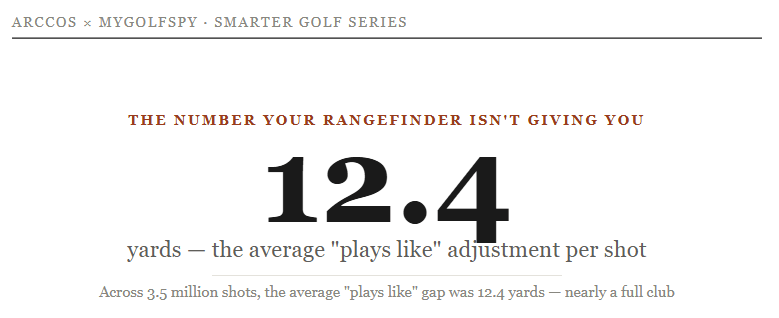
The rangefinder category has operated on a single promise for two decades: point at the flag, get an accurate number. Arccos just released data from 3.5 million Smart Laser shots arguing that promise was never the right one to make. The number your rangefinder gives you is technically correct. It is also, according to this dataset, wrong by 10 yards or more on half of every shot you hit.
What Is Plays Like Distance in Golf?
The argument hinges on what Arccos calls "plays like" distance, the gap between raw yardage and the yardage the shot actually requires once environmental factors are calculated. Wind accounts for nearly 64 percent of that gap. Temperature, altitude, and humidity cover most of the rest. Slope, the feature rangefinder brands have spent a decade marketing as the solution, handles less than 20 percent. On 91 percent of shots in the dataset, the non-slope adjustment outweighed the slope adjustment. That statistic alone reframes what a premium rangefinder is supposed to do.
The strategic timing here matters. Arccos released this data through MyGolfSpy, a publication that has spent years establishing credibility as an independent testing authority. The partnership lends the findings a layer of third-party validation that a standalone Arccos blog post would not carry. It is also a content play designed to convert during peak rangefinder shopping season. The article includes a direct purchase link. The framing is editorial, but the intent is commercial. That dual purpose does not invalidate the data, but it does explain why the data is being surfaced now and in this format.
How Does Arccos Golf Data Pressure Rivals?
The competitive implications extend beyond Arccos. Bushnell, Garmin, and Precision Pro have built their rangefinder marketing around slope adjustment as a premium differentiator. If slope solves less than a fifth of the problem, the value proposition of a $400 slope model versus a $250 non-slope model gets harder to justify. Arccos is not just selling its own product here. It is attempting to redefine what the category should be measured against. That is a brand-building exercise as much as a sales pitch.
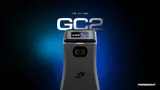
The underlying technology is not new. Arccos has offered environmental adjustments through its app and caddie system for years. The Smart Laser, launched in 2024, packaged that capability into a standalone rangefinder form factor. What the 3.5 million shot dataset provides is scale. Previous claims about "plays like" distance were theoretical or based on smaller sample sizes. This release anchors the argument in a volume of real-world data that competitors cannot easily dismiss or replicate. Bushnell does not have 3.5 million shots of environmental data. Neither does Garmin.
The TPC Sawgrass example in the release is instructive. Same hole, same slope, five different days, yardage adjustments ranging from zero to 23 yards. That is the kind of concrete illustration that sticks with a golfer standing over a 140-yard shot wondering why they keep coming up short. It also demonstrates what Arccos is betting on: that golfers who understand the problem will pay to solve it. The Smart Laser retails at a premium to most slope-only models. The data is the justification for that premium.
Can Arccos Redefine Rangefinder Accuracy for Golfers?
Arccos sits at 37th in the DORMIED global rankings with a 22 percent month-over-month gain. That trajectory reflects a brand finding its footing in a category it is trying to redefine rather than compete within. The rangefinder market has been static for years, with incremental improvements to magnification, display, and battery life but no fundamental rethinking of what the device should measure. Arccos is making the case that the category has been solving the wrong problem.
Whether that case converts into market share depends on whether golfers care more about being technically accurate or being practically correct. The 3.5 million shot dataset suggests those are not the same thing. For a brand that has spent a decade trying to convince golfers that data improves their game, this release is the clearest articulation yet of what that data is worth.