Twenty thousand tournament entries from a thousand players in five months is not a product launch. It is a proof of concept for an entirely different business model, one that treats indoor golf less like a driving range with walls and more like a platform for continuous competitive play.
How Do Five Iron Golf Tournaments Work?
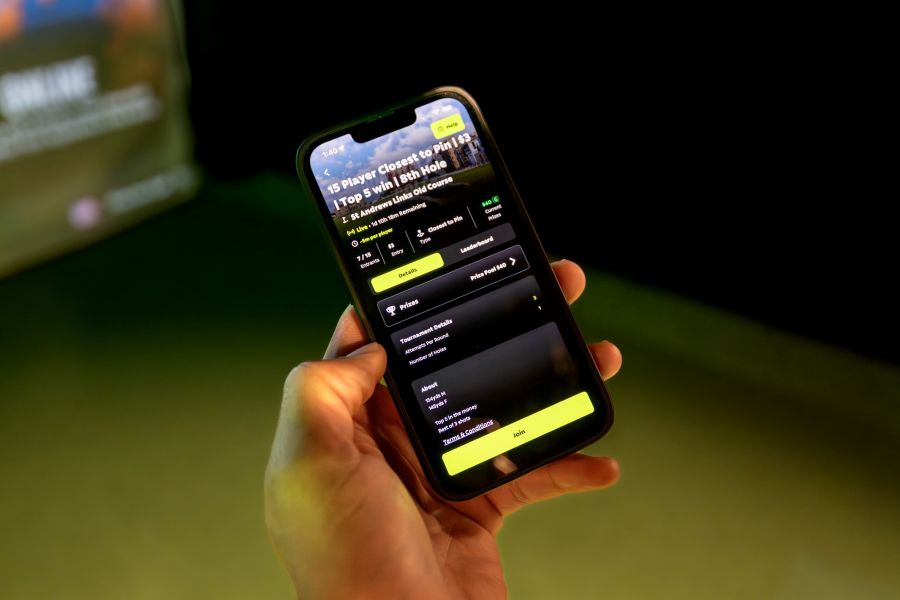
Five Iron Golf's new tournament platform, rolling out across 15 markets this spring with a full national launch by late summer, lets players enter real-money competitions on demand from any of the company's 500-plus TrackMan bays. Stroke play, scramble, closest to the pin, live leaderboards, guaranteed prize pools. The infrastructure mirrors what daily fantasy and online poker built for their categories: always-on competition at every stakes level, designed to convert casual participants into repeat players. The 65% same-month return rate from the beta suggests the model is working.
The timing matters. Indoor golf has spent the past decade building credibility as a year-round alternative to outdoor play, but the category has struggled to define what it actually is beyond a weather hedge. Topgolf turned it into nightlife. Five Iron, with its emphasis on instruction, fitting, and league play, positioned itself closer to the serious-golfer segment. This tournament platform is a bet that the serious-golfer segment wants something golf courses cannot offer: flexible, competitive play that fits into a Tuesday night instead of a Saturday morning.
Why Did Callaway Invest in Five Iron?
Callaway's investment in Five Iron, alongside Danny Meyer's Enlightened Hospitality Investments, positions the OEM closer to this emerging competitive layer than any of its peers. The strategic logic is straightforward. If indoor golf becomes a legitimate venue for serious competitive play, equipment decisions made in those bays start to matter. Fitting sessions at Five Iron already feed Callaway's retail pipeline. A tournament platform that keeps players coming back weekly deepens that relationship. It is the same calculus that led club manufacturers to sponsor mini-tours and amateur events for decades, except the venue is climate-controlled and the schedule is infinitely more flexible.
The competitive landscape for indoor golf real-money play is effectively empty. Topgolf has resisted moving toward skill-based gambling, preferring to protect its entertainment positioning and avoid the regulatory complexity. Simulator bars and lounges lack the scale to build a national network. Five Iron's 50 locations across seven countries, with 800 employees and the infrastructure to support synchronized tournaments across time zones, represents a barrier to entry that took nearly a decade and significant capital to build. The company is not launching a feature. It is launching a moat.
What Could Limit Indoor Golf Competition Growth?
Whether this transforms indoor golf or remains a niche within Five Iron's membership depends on two variables the company cannot fully control: regulatory expansion and golfer behavior at scale. Real-money competition in indoor sports exists in a patchwork of state-level gaming laws, and Five Iron's initial 11-state footprint reflects that reality. The company's expansion timeline suggests confidence that additional states will open, but the regulatory path is neither guaranteed nor fast. Golfer behavior is the harder question. The beta data shows strong retention among early adopters, but early adopters self-select for enthusiasm. The test is whether a broader membership base, including the players who show up for happy hour and corporate outings, converts into tournament participants at rates that justify the infrastructure investment.
The June closest-to-the-pin series, with $20,000 in guaranteed prize pools across 20 tournaments on iconic course simulations, is designed to answer that question. It is a low-friction entry point: one shot, clear leaderboard, real money. If Five Iron can convert casual bay renters into repeat tournament entrants through that format, the model scales. If the tournament platform remains the domain of the same thousand players who found the beta, it becomes a loyalty play rather than a growth engine.
Five Iron's trajectory from a four-bay concept in the Flatiron District to a 50-location international network already qualifies as one of the more successful startup stories in modern golf. The tournament platform is a bet that the next phase of growth comes not from opening more locations but from extracting more engagement from the locations that already exist. For Callaway, the investment is a hedge on where competitive golf participation is heading. For the rest of the industry, it is a signal worth watching.